
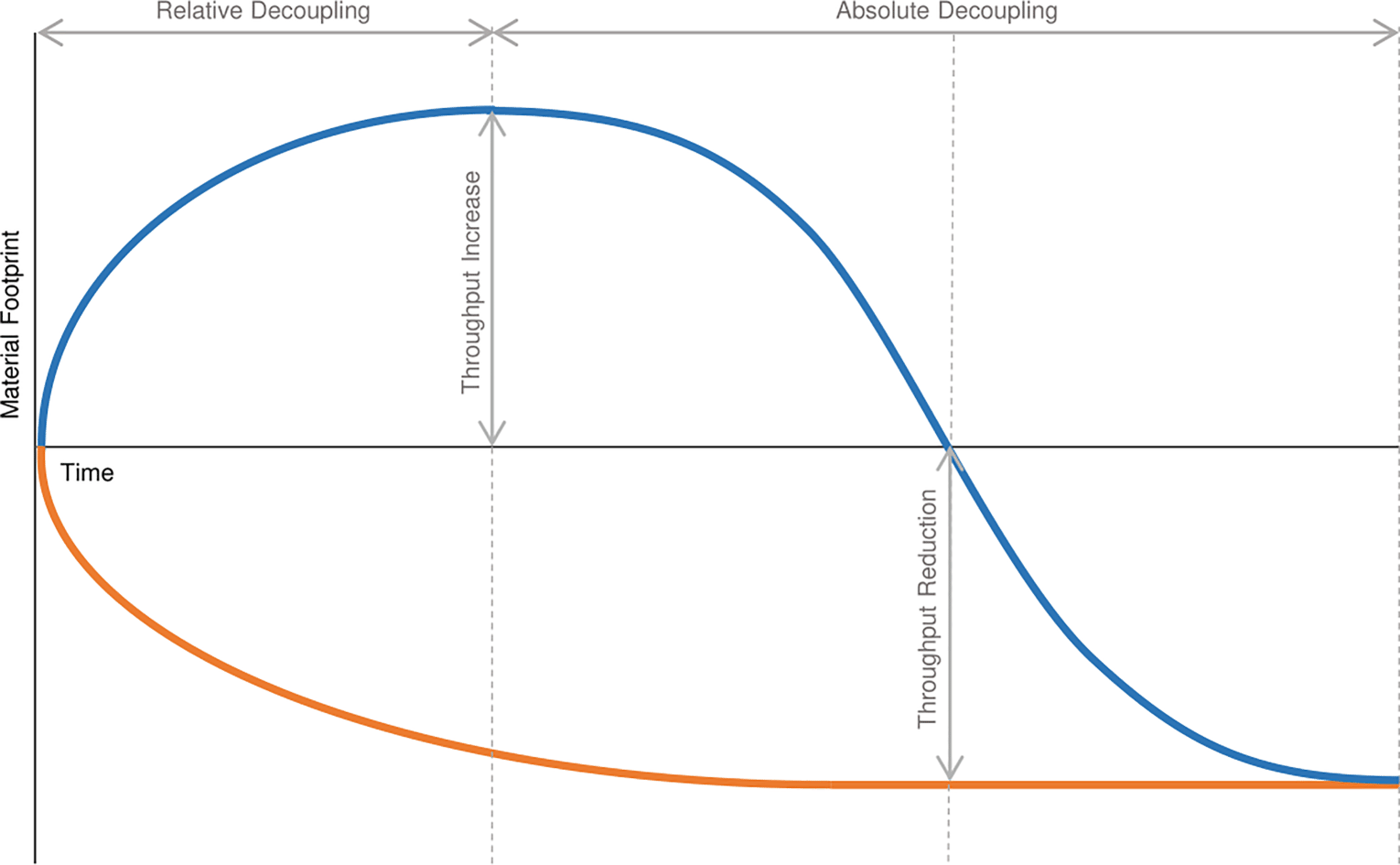
Underlying this urban planning narrative, there is a tendency to limit city-related problems to the discrete land the cities occupy (Angelo/Wachsmuth 2015), which leads to measure sustainability in terms of the improved performance of the objects occupying urban land – the buildings and infrastructure that make cities. Such implicit framing within mainstream urban planning is, similar to mainstream economics, blind to the material and energy basis of urbanisation, which lies outside of cities themselves. The limitations of efficiency increase as a sustainability strategy has long been investigated by ecological economists (Daly 1996; Hickel/Kallis 2020), who focus on the material foundations of economic activities. In urban studies, it is only recently that attention has been given to the material ties of cities to their hinterlands (Kaika 2005), while mostly anecdotal evidence shows the dependency of cities on other-than-cities as, for example, approximately 70 % of the iron used for steel in the European construction industry is sourced out of Europe (Jaganmohan 2024; Kolisnichenko 2024). To complicate this picture, ecological economists point out that material consumption is not fixed but rather an outcome of social practices – and is, thus, linked to our notion of needs. And this behavioural dimension becomes even more problematic in “advanced” countries. In Germany, for example, buildings have a diminishing lifespan (currently at 60 years average) despite its advanced “green” building construction legislation; and rebound effects in housing energy consumption are apparent despite the energy gains provided by its high technological standards.
To address the shortcomings of resource efficiency strategies, ecological economists focus on sufficiency, namely reducing aggregate material throughput by downscaling resource production and consumption, as illustrated in orange in Figure 1. While ultimately both efficiency and sufficiency strategies seek sustainability, they hold opposing assumptions about the substitutability of nature and labour, and, in consequence, they align with two different discursive arenas that, at least in their first stages of deployment, are antithetical. And while ecomodernisation does not question our perception of current material comfort, degrowth implies such questioning. In the context of cities, the strategy of sufficiency requires that urban areas are considered not as cartographical objects but as parts of a network enabled by material flows sent from somewhere else (Kaika 2005). In this view, the material changes within urban territories (which are the focus of ecomodernisation) are the first-order effects of urbanisation that rely on larger, second-order effects of urbanisation: the transformation of adjacent, national, and remote territories that supply materials for cities, and which may be impacted by pollution, biodiversity loss, and environmental injustices (Rees 2018). As we change the perspective, we subsequently have to question the normative making of cities: How should low-impact cities be envisioned? What urban planning tools may facilitate low-impact cities? All these considerations demand that we re-evaluate sustainable, local urban planning practices.
Internalising the impacts of urbanisation in other-than-urban landscapes requires a different imaginary of urban sustainability away from luscious green buildings and parks and towards adopting lifestyles with reduced resource consumption. If urbanisation is understood as a material practice that fundamentally accumulates materials extracted from the territories outside cities, then the normative goal of urban planning should not just be to make resource consumption more efficient but also to reduce resource consumption itself. Degrowth scholars aligned with ecological economics’ postulates in the fields of urban planning have broadly underscored the need to downscale harmful production, prioritise bottom-up and frugal innovations, and promote communing (Nelson/Schneider 2019; Savini/Ferreira/von Schönfeld 2022). Yet only liminal research has gone into identifying spatial and planning scenarios that can drastically reduce the material throughput of cities (De Castro Mazarro/George Kaliaden/Wende et al. 2023). Two envisioning strategies can be used to outline low-impact city imaginaries: counter-imaging techno-utopias and scaling-up urban sufficiency examples in political ecological literature. Selected cases are described below, following the spatial scales of the building, the urban, and the territory.
At the building scale, criticism of ecomodernism appears in the controversy surrounding the “Vertical Forest” tower by Boeri architects in Milano, a sumptuous poster child of the green building industry.1 Despite its luscious use of nature in facades, the prioritisation of plants in the building has been critiqued for hiding otherwise unsustainable land dynamics, especially the sealing of urban land for individual mobility (Alter 2020). The grey embodied energy of the tower increases through the complex artificial setting required to sustain the plants, and through the reinforcement of the concrete structure holding the weight of soil, plants, and insulation system. As an alternative to the high-metabolic material consumption of green buildings, the low-impact city offers a novel construction marketplace of reusable, compostable construction systems and appropriate technologies, as well as frugal building renovations. Radical practices like Biome Environmental Solutions2 in Bangalore try to close the material loop of building materials by using the very earth dug from the buildings’ basements as their primary construction material. In Europe, the design office Rotor in Belgium3 produces architectural designs that include salvaged building parts, and operates as a de-construction company that dismantles and resells such building parts. Although these sufficiency innovations may provide radical alternatives to efficiency solutions worthy of broad implementation, they require engagement from urban planners in reworking building and zoning codes that reflect lifestyle changes aligned towards degrowth.
At the urban scale, the critique of the low-carbon city imaginary appears in the controversial development of the Highline Park in New York City, a semi-public green space that follows the tracks of an old, elevated train line in Manhattan. While the park has been celebrated for its sophisticated renaturing of sealed land in a dense city context, it has also been critiqued for the gentrification caused by the real estate boom in the neighbourhood surrounding it, as well as for the unequal tax system that allows the park to reinvest its own value capture (Jo Black/Richards 2020). To avoid housing financialisation – which leads to unnecessary housing production – the low-impact city, in contrast, needs to promote collective and shared uses. A rare paradigm of such an approach to urban design is the celebrated Leon Aucouc Square, designed by Lacaton & Vassal in the late 1990s.4 This project was based on an urban design competition where the architects upgraded this public space, which was considered unremarkable until then, by removing the car parking areas, relocating garbage lots, and installing minimal public furniture. Lacaton & Vassal enhanced the character of the square with a minimal intervention that has, since then, become a landmark for sufficiency in urban design. Yet, the exceptionality of this case shows that decoupling the creation of public space from resource consumption requires social campaigns that help shift public opinion towards accepting a different lifestyle where public spaces are not commodified.
The hinterlands are critical for the resources that facilitate urbanisation. Yet, in urban planning discourse they are, perhaps by definition, unproblematised territories. The geographic and social marginality of these territories, especially those situated at the beginning of global supply chains, makes them ideal candidates to internalise the environmental conflicts embedded in cities’ resource consumption. An example of these conflicts can be drawn from the contrast between the ambitious goal of transitioning to 100 % renewable energy, celebrated by urban residents worldwide, and the significant spatial footprint required to produce such renewable energy sources (Hoicka/Conroy/Berka 2021). The sites used for renewable energy production are often rural regions surrounding cities and far-off geographies that provide the critical minerals needed to produce renewable energy infrastructure. While other-than-urban territories are frequently considered the price one needs to pay for the transition, drastically reducing urban energy consumption and re-introducing passive energy designs could prevent the release of new landscapes for energy production. Unfortunately, alternatives to the extractivist urban energy transition are now emerging by disaster rather than by design, like the recent reduction in energy use in Europe due to increasing energy costs caused by the global shocks in supply chains. Similar challenges to the extractivist nature of the urban energy transition are emerging through resistance movements that challenge the location of mines, transmission lines, wind and solar farms, and disposal sites on their territories, which demand inclusive participation in spatial planning processes, and to adequately share costs and benefits. For urban planners to facilitate the creation of a low-impact city, it is necessary to engage and include the voices of actors from more-than urban territories through new governance arrangements.
We argue that urban sustainability cannot be fully addressed unless the material linkages of urbanisation are internalised in urban planning discourse. Yet, this material dimension of low-impact cities implies adapting to a different experience of comfort in buildings and public spaces. While such change could potentially challenge the extractive relationship existing between the urban and the other-than-urban, the current absence of central planning and building examples for low-impact cities suggests that urban planning, as we know it now, may be unfit to deliver such a change. We argue that to internalise the imaginary of the low-impact city in the agenda of urban sustainability, incremental changes in the normative frameworks of urban planning will not suffice. Instead, we posit that a social science-oriented vision of urban planning, reframing and examining urban needs and urban behaviour, still has to be developed to fulfil the sustainability aspirations of current mainstream urban planning.
References
| Alter, L. (2020): Another Look at Stefano Boeri’s Vertical Forest. https://www.treehugger.com/another-look-stefano-boeris-vertical-forest-4859164 (27.04.2024). |
| Angelo, H.; Wachsmuth, D. (2015): Urbanizing Urban Political Ecology: A Critique of Methodological Cityism. In: International Journal of Urban and Regional Research 39, 1, 16–27. https://doi.org/10.1111/1468-2427.12105 |
| Daly, H.E. (1996): Beyond growth: The economics of sustainable development. Boston. |
| De Castro Mazarro, A.; George Kaliaden, R.; Wende, W.; Egermann, M. (2023): Beyond urban ecomodernism: How can degrowth-aligned spatial practices enhance urban sustainability transformations. In: Urban Studies 60, 7, 1304–1315. https://doi.org/10.1177/00420980221148107 |
| Hickel, J.; Kallis, G. (2020): Is Green Growth Possible? In: New Political Economy 25, 4, 469–486. https://doi.org/10.1080/13563467.2019.1598964 |
| Hoicka, C.E.; Conroy, J.; Berka, A.L. (2021): Reconfiguring actors and infrastructure in city renewable energy transitions: A regional perspective. In: Energy Policy 158, 112544. https://doi.org/10.1016/j.enpol.2021.112544 |
| Jaganmohan, M. (2024): Apparent iron ore consumption worldwide by region 2019. https://www.statista.com/statistics/590173/apparent-iron-ore-consumption-worldwide-by-region (27.05.2024). |
| Jo Black, K.; Richards, M. (2020): Eco-gentrification and who benefits from urban green amenities: NYC’s high Line. In: Landscape and Urban Planning 204, 103900. https://doi.org/10.1016/j.landurbplan.2020.103900 |
| Kaika, M. (2005). City of flows: Modernity, nature, and the city. New York. |
| Kolisnichenko, V. (2024): EU reduced iron ore imports by 11 % y/y in 2023. https://gmk.center/en/news/eu-reduced-iron-ore-imports-by-11-y-y-in-2023 (27.05.2024). |
| Leal, P.H.; Marques, A.C. (2022): The evolution of the environmental Kuznets curve hypothesis assessment: A literature review under a critical analysis perspective. In: Heliyon 8, 11, e11521. https://doi.org/10.1016/j.heliyon.2022.e11521 |
| Nelson, A.; Schneider, F. (2019): Housing for degrowth: Principles, models, challenges and opportunities. London. |
| Rees, W.E. (2018): Planning in the Anthropocene. In: Gunder, M.; Madanipour, A.; Watson, V. (eds.): The Routledge Handbook of Planning Theory. New York, 53–66. |
| Savini, F.; Ferreira, A.; von Schönfeld, K.C. (2022): Post-Growth Planning: Cities Beyond the Market Economy. New York. https://doi.org/10.4324/9781003160984 |
Footnotes
| 1 | https://www.stefanoboeriarchitetti.net/en/project/vertical-forest/ (27.04.2024). |
| 2 | https://www.biome-solutions.com (27.04.2024). |
| 3 | https://rotordb.org (27.04.2024). |
| 4 | https://www.lacatonvassal.com/index.php?idp=37 (27.04.2024). |