
In recent decades, conventional comprehensive planning has increasingly been criticized for its limited ability to respond to rapid urbanization, socio-economic restructuring, environmental pressures, and the growing complexity of spatial development. Critiques of rigid land-use planning, combined with the search for more flexible, implementation-oriented, and governance-based approaches, have contributed to the growing prominence of Strategic Spatial Planning (SSP) in contemporary planning debates. Strategic Spatial Planning is generally understood not simply as a softer version of statutory planning, but as a strategic framework that connects long-term visions, spatial priorities, governance arrangements, and implementation capacity.
Yet the transition toward such an approach has not followed a uniform path across planning systems. In some contexts, strategic and spatial functions remain weakly integrated or are distributed across different instruments. Türkiye provides a particularly revealing case in this respect. Rather than developing a single coherent upper-scale planning framework, the Turkish planning system has evolved around two separate tools that embody different dimensions of planning. On the one hand, the Strategic Plan introduces vision, priorities, and policy orientation, but remains largely non-spatial. On the other hand, the Environmental Plan provides the principal upper-scale spatial framework, yet does so using rigid, hierarchical, and insufficiently strategic logic. As a result, upper-scale planning in Türkiye is shaped less by the integration of strategy and spatiality than by their institutional separation.
This fragmentation is significant not only for understanding the Turkish planning system, but also for broader debates on Strategic Spatial Planning. The literature has long emphasized the importance of linking strategy, spatial articulation, governance, and implementation. The Turkish case shows what happens when these dimensions are distributed across separate plan types rather than combined within a coherent upper-scale framework. Hence, this paper does not treat Türkiye merely as a national case of planning reform. It rather uses the Turkish experience to examine a wider problem of institutional and conceptual fragmentation in upper-scale planning.
For the purposes of this paper, ‘upper-scale planning’ refers to all planning instruments operating above the level of local statutory plans (prepared at 1/5,000-1/25,000 scales), encompassing regional, basin-level (havza – referring to hydrological catchment areas or river basins designated as planning units for environmental and land-use management purposes), and national instruments. The content and institutional characteristics of the key upper-scale instruments in the Turkish context (particularly Environmental Plans) are discussed in detail in Section 3.
Against this background, this paper asks whether the existing dual structure of upper-scale planning in Türkiye can adequately respond to contemporary territorial challenges, and if not, what kind of planning model might overcome these limitations. It argues that the main problem lies not in the failure of one plan alone, but in the separation of strategic and spatial capacities across two incomplete instruments. The paper therefore proposes a Strategic Spatial Planning model for Türkiye that selectively integrates the strengths of the Strategic Plan and the Environmental Plan while avoiding their recognized weaknesses.
Document Category | Specific Document | Type | Role in Analysis |
|---|---|---|---|
Planning legislation | Zoning Law 3194 | Law | Defines Environmental Plan’s legal basis, scope, and position in planning hierarchy |
Planning legislation | Regulation on the Principles of Plan Making (1985) | Regulation | Specifies Environmental Plan scales, content, and approval procedures |
Planning legislation | 5393 Municipal Law | Law | Establishes Strategic Plan as a mandatory instrument for municipalities |
Planning legislation | 5302 Special Provincial Administration Law | Law | Introduces Provincial Environmental Plan; source of authority conflicts |
Planning legislation | 2004 Metropolitan Municipality Law | Law | Source of scalar ambiguity between master plans and Environmental Plans |
Planning legislation | Environment Law | Law | Redefines Environmental Plan scales; basis of discrepancy with planning regulation |
Policy document | 8th Five-Year Development Plan (2001-2005) | Development plan | Documents institutionalization of strategic planning at national level |
Spatial plan | 1/100,000-scale Mersin-Karaman Environmental Plan (2009) | Upper-scale spatial plan | Illustrates rigid land-use logic, over-determination, and weak strategic content |
Spatial plan | 1/25,000-scale Mersin Master Plan | Statutory urban plan | Comparative basis for demonstrating representational similarity across scales |
Territorial framework | NUTS‑2 Regional Plan boundaries vs. Environmental Plan boundaries (Southeast Türkiye) | Cartographic comparison | Illustrates scalar mismatch and fragmented territorial governance |
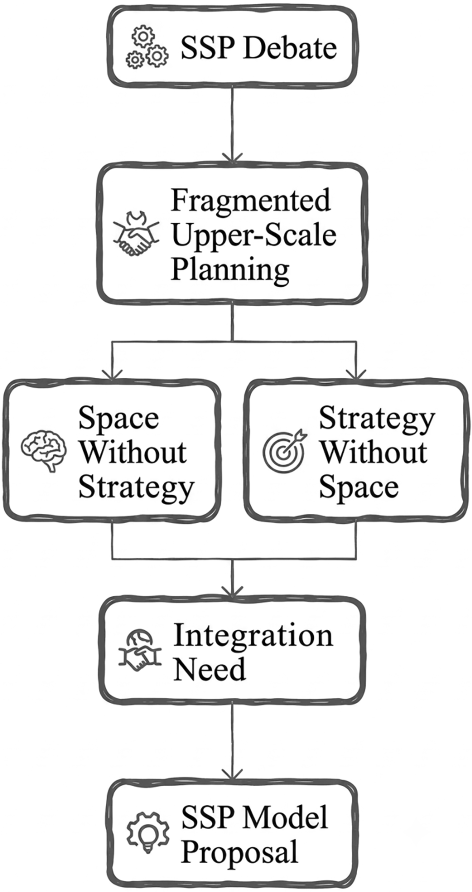
The paper first reviews the conceptual foundations and governance dimensions of Strategic Spatial Planning (Section 2), then examines the institutional evolution of upper-scale planning in Türkiye (Section 3) and subsequently analyses the contradictions of both plan types (Sections 4 and 5). On this basis, a Strategic Spatial Planning model for Türkiye is then developed and discussed (Section 6).
Strategic Spatial Planning (SSP) emerged as an alternative to conventional regulatory planning, which has been criticized for its reliance on rigid zoning regulations and static plan outputs. Unlike traditional land-use planning, Strategic Spatial Planning is not defined by a specific scale, but can operate at urban, regional, or national levels depending on context. In the literature, this shift is closely associated with Louis Albrechts, who defines planning not merely as a technical activity concerned with the physical organization of space, but as a socio-spatial process oriented toward transformation (Albrechts 2004). Strategic Spatial Planning therefore seeks to generate socio-spatial innovation, explore possibilities for radical change, and construct long-term collective visions through selective short-term interventions. The plan thus becomes less a fixed map or regulatory document than a dynamic process focused on key issues, action, and implementation capacity (Albrechts 2004; Albrechts 2010). More radical interpretations further argue that Strategic Spatial Planning should challenge spatial inequalities and redistribute resources and opportunities across territory (Fainstein 2010).
The revival of Strategic Spatial Planning is also linked to broader transformations in spatial governance. Globalization strengthened concerns about territorial competitiveness, leading to investments in transport, tourism, and place-based development, while environmental agendas brought increased attention to urban and ecological assets and quality of life. Consequently, spatial planning came to address economic and environmental concerns simultaneously, becoming more multidimensional in scope (Albrechts 2005; Gedikli 2010). Strategic Spatial Planning should therefore be understood not as a narrow land-use management technique, but as a strategic planning approach characterized by long-term thinking, interaction, process orientation, comprehensiveness, participation, and relational connectedness (Sartorio 2005).
A further dimension of Strategic Spatial Planning concerns the shift from technocratic and positivist planning models toward communicative and governance-oriented approaches. From the late 1980s onward, spatial planning was increasingly influenced by critiques of instrumental rationality and by perspectives emphasizing negotiation, consensus-building, and stakeholder inclusion (Blotevogel 2000). As Gedikli (2007) notes, this transformation introduced social networks into urban decision-making and advanced communicative rationality, in contrast to the instrumental rationality of modernist planning. Strategic Spatial Planning can therefore be interpreted as part of a broader communicative turn from top-down planning toward interactive, negotiated, and cooperative spatial decision-making.
Within this shift, Strategic Spatial Planning has increasingly been framed through governance rather than expert-led hierarchy. Healey (1996) emphasizes planning as a process in which different actors discuss spatial issues, confront diverse forms of knowledge, and develop shared understandings and agreed directions. Planning knowledge is thus produced not only by experts, but through interaction among technical knowledge, institutional experience, and local perspectives. Such collaborative processes can strengthen the legitimacy and feasibility of planning decisions by helping actors identify common goals and build collective commitment, particularly in fragmented contexts (Healey 1997; Healey 2007). This governance-oriented understanding is also reflected in the UN-Habitat guidelines, which emphasize multi-level coordination, participation, and the integration of spatial and development strategies as core principles of effective planning practice (UN-Habitat 2015).
This governance perspective is closely related to changing planning scales and decision-making arenas. Cremer-Schulte (2014) argues that transformations in European spatial planning are embedded in territorial rescaling and state re-territorialization. Accordingly, Strategic Spatial Planning not only operates within formal hierarchical scales but has also contributed to the emergence of ‘soft’ governance spaces shaped by flexible and hybrid institutional arrangements. Planning increasingly takes place between statutory instruments and informal arenas of coordination, negotiation, and strategy making. Strategic Spatial Planning should therefore be assessed not only through its formal outputs, but also through the governance configurations, decision-making spaces, and scalar arrangements that shape planning processes.
However, the transformative capacity attributed to Strategic Spatial Planning is not always realized in practice. Taylor (2010) questions whether Strategic Spatial Planning truly transcends traditional land-use planning, arguing that strategic discourse may remain rhetorical when plans continue to be structured around land-use regulation. A related criticism concerns the gap between higher-level visions and the implementation of local spatial decisions, especially where there are tensions between the goals of growth and sustainability and where weak inter-governmental coordination limits strategic ambitions (Albrechts 2001; Palakodeti 2020). These critiques suggest that Strategic Spatial Planning depends not only on vision making, but also on the institutional arrangements and implementation capacities required to support it.
Conceptually, strategic planning is often understood less as an approach that directly produces tangible outcomes than as a framework guiding subsequent decisions and actions (Allin/Walsh 2010). Referring to Faludi (2000), it can be seen as a continuing process that informs later decisions under uncertainty, while Hopkins (2001) emphasizes planning’s role in decision-making conducted in situations of interdependence, irreversibility, and incomplete knowledge of the future. At the same time, Strategic Spatial Planning is not merely an instrumental coordination mechanism; it is also a process in which goals, values, and priorities are negotiated (Healey 1997). Louis Albrechts’ definition of Strategic Spatial Planning as a public-sector-led socio-spatial process through which visions, actions, and implementation tools are jointly produced reinforces this view (Albrechts 2004). Yet, as Sartorio (2005) notes, Strategic Spatial Planning remains conceptually ambiguous and context-dependent, shaped by institutional structures, power relations, and implementation conditions.
Recent contributions refine these debates in three ways. First, scholars call for Strategic Spatial Planning to be revitalized as a proactive and adaptive framework capable of responding to climate change, governance complexity, and non-linear planning temporalities (Hutter/Wiechmann 2022; Olesen 2023). Second, empirical studies show that Strategic Spatial Planning operates differently across contexts, enabling flexible development trajectories in shrinking regions while revealing persistent weaknesses in strategic capacity elsewhere (Oittinen/Mäntysalo 2024; Phelps/Valler 2024). Third, recent work broadens Strategic Spatial Planning beyond growth-oriented agendas and highlights continuing challenges of participation and implementation (Hossu/Oliveira/Niță 2022; Savini 2025; Trygg/Grundel 2025). Together, this literature confirms that Strategic Spatial Planning is best understood as a flexible and context-dependent planning approach whose effectiveness depends on its capacity to respond to shifting socio-spatial and governance conditions.
Finally, clarifying Strategic Spatial Planning also requires asking what forms of spatial representation can genuinely be considered strategic. Healey (2009) argues that plans may claim strategic significance while remaining tied to conventional land-use mapping; genuinely strategic representations are selective and relational, communicating directional choices and territorial priorities rather than fixed allocations. A plan becomes strategic not because of its scalar position, but because its representational language guides future decisions without closing them down. This is important for assessing Strategic Spatial Planning in practice. Hersperger, Grădinaru, Oliveira et al. (2019) distinguish between plan making, which produces visions and decision frameworks, and plan implementation, which translates intentions into spatial transformation, noting the role of cartographic and graphic representations in this process. Strategic Spatial Planning must therefore be evaluated not only through its communicative claims, but also according to whether those claims can be institutionalized, spatially represented, and implemented in specific planning contexts.
Since 2013, central government roles in planning have gradually strengthened, and the 2018 transition to a presidential system further consolidated national-level decision-making, redefining local government roles and inter-scalar coordination mechanisms. Scholarship on urban governance in Türkiye situates these changes within neoliberal urbanization dynamics. Thus Balaban (2012) highlights the effects of construction-led growth on planning, Kuyucu and Ünsal (2010) examine the restructuring of urban regeneration through property relations and state intervention, Ataöv and Eraydın (2011) and Kayasü and Yetişkul (2014) show how metropolitan governance and legal-institutional frameworks have been reshaped alongside neoliberal policy shifts. Together, these studies indicate that the Turkish planning system has been shaped by administrative centralization, market-led development, and fragmented planning authority.
When considered in terms of comparative planning system frameworks, Türkiye shows some proximity to both the land-use regulation-based and the comprehensive-integrated categories, without fully fitting either (Nadin/Stead 2013). Strong central administrative traditions, multi-layered authority, and the separation between spatial and strategic instruments make the Turkish system a hybrid case that challenges Eurocentric classifications.
In Türkiye, the rise of strategic planning was shaped less by the direct adoption of Strategic Spatial Planning as a spatial model than by broader changes in local governance, participation, and public administration. Since the 1970s, debates on local democracy and participation gained visibility, particularly through social democratic municipalities in metropolitan areas, where public involvement began to be treated as part of urban governance (Özcan 2000). This tendency strengthened during the 1980s and 1990s, as the growing role of local governments, changing development perspectives, global economic restructuring, and Türkiye’s EU accession process increased interest in strategic approaches to planning and management (Polat 2011). Participatory approaches were further reinforced after the 1992 United Nations Rio Conference, with the Local Agenda 21 process helping translate this principle into local practice.
By the early 2000s, participation and strategy had entered national planning and administrative agendas more explicitly. The eighth Five-Year Development Plan (2001-2005) emphasized strategic approaches at regional and sub-regional scales, and this focus was institutionalized through post-2004 public administration reforms. Strategic planning entered the Turkish legislative framework through laws on municipalities, special provincial administrations, and other public institutions, becoming part of a reform agenda focused on performance, accountability, and administrative coordination (Gedikli 2010). This shift was also shaped by OECD public administration guidelines, World Bank performance-based governance agendas, and Türkiye’s EU accession process, all of which promoted strategic planning as a tool of administrative modernization.
This institutionalization was consolidated through the 5393 Municipal Law and the 5302 Special Provincial Administration Law, which required relevant local authorities to prepare strategic plans. These laws assigned local administrations responsibility for preparing, approving, and implementing plans in consultation with universities, professional chambers, and non-governmental organizations, and in conformity with higher-level planning decisions. However, while this framework made strategic planning mandatory in public administration, it did not clearly define it as a spatial planning tool within the formal planning hierarchy. Strategic planning in Türkiye therefore developed mainly as an administrative and managerial practice concerned with institutional performance, budgeting, accountability, and coordination, rather than as a fully spatialized upper-scale planning instrument.
It should be noted that ‘upper-scale planning’ is not a homogeneous category. Strategic plans generally articulate values, visions, and broad policy directions; sectoral plans identify development priorities without specifying sites; and spatial plans translate these focuses into land-use frameworks. Gaps between these instrument types are a structural feature of planning systems more broadly, not a problem unique to Türkiye.
In the Turkish context, upper-scale planning refers to spatial and strategic instruments operating above statutory urban plans. Such instruments shape territorial development through broad policy orientations, land-use frameworks, and inter-institutional coordination. They include the national Spatial Strategy Plan, Environmental Plans at regional and provincial scales, and non-statutory strategic documents such as regional development strategies. Instruments such as the nationwide Spatial Strategy Plan (2018), the National Strategy for Regional Development (2014), and the planning decisions of actors like the Housing Development Administration also shape spatial outcomes, although they fall outside the statutory planning hierarchy. This paper focuses specifically on Environmental Plans and Strategic Plans in order to examine the institutional separation between spatially binding capacities and strategic capacities. Other instruments are acknowledged but remain outside the analytical scope of the discussion.
The institutional landscape of upper-scale planning in Türkiye is therefore organized not around a single integrated instrument, but around multiple planning and policy documents operating at different scales and under different legal mandates. This fragmented structure is crucial for understanding the relationship between Regional Plans, Environmental Plans, and Strategic Plans, which do not all belong to the same legal hierarchy yet nonetheless influence upper-scale spatial decision-making. Regional Plans formulate broader development priorities and socio-economic strategies, while statutory spatial planning follows the formal hierarchy defined by planning legislation. Within this framework, the Environmental Plan occupies a key upper-scale position. Prepared at regional, basin, or provincial level, generally at 1/50,000 or 1/100,000 scale, it establishes general land-use decisions on settlement patterns, development areas, sectoral uses, and the protection-use balance. It thus serves as the main instrument translating regional and sectoral policy orientations into spatial decisions and guiding lower-scale plans. Yet, because it stands between regional policy frameworks and statutory urban plans, its position in the Turkish planning system remains conceptually and institutionally contentious.
In the Turkish planning system, the Environmental Plan is the principal upper-scale spatial planning instrument through which broad land-use decisions are translated into territorial frameworks at regional, basin, or provincial scales. According to Zoning Law 3194 and subsequent regulations on plan-making principles, it aims to balance protection and use by determining the spatial distribution of major sectors such as housing, industry, agriculture, tourism, and transportation, while guiding the development of natural and cultural resources. Generally prepared at scales such as 1/25,000, 1/50,000, or 1/100,000, it consists of a physical plan, plan notes, and a report, and provides the framework for lower-scale planning.
The Environmental Plan was formally introduced into planning legislation with the 1985 Zoning Law, evolving from earlier ‘Adjacent Area Plans’ prepared at 1/25,000 scale for peri-urban areas (Duyguluer 2005). Since the law did not define the plan’s content or procedures in detail, these were later specified through the ‘Regulation on the Principles of Plan Making’.
In the following decades, Environmental Planning underwent several administrative and legal revisions, including authority disputes between ministries in the early 2000s, the 2005 reform empowering special provincial administrations to prepare Provincial Environmental Plans, and the 2011 restructuring that consolidated authority under the newly established Ministry of Environment and Urban Planning (Ersoy 2006). These successive changes reveal the contested and unstable governance of upper-scale spatial planning in Türkiye rather than a coherent institutional trajectory.
Within the Turkish planning hierarchy, the Environmental Plan occupies an intermediate yet influential position between regional development frameworks and lower-scale statutory plans. Although it functions as the main upper-scale spatial framework guiding subsequent planning stages, its relationship with regional development frameworks, sectoral policies, and other planning instruments remains institutionally complex. The plan’s central but ambiguous position at the intersection of regional policymaking, land-use regulation, and administrative coordination has therefore generated continuing debates over its scale, authority, and scope. The following section examines the contradictions that have emerged around the Environmental Plan in Türkiye.
Despite its central position, the Environmental Plan has produced persistent contradictions that weaken its effectiveness as an upper-scale planning instrument. These contradictions can be grouped as administrative, scalar, and structural. Together, they show that the Environmental Plan occupies an ambiguous position between regional policy frameworks and statutory spatial planning, while failing to provide either a coherent governance model or a sufficiently strategic spatial framework.
A major administrative contradiction concerns the dominance of centralization over decentralization and participation. In the governance literature, the transfer of powers from central to local authorities is associated with democratization, responsiveness to local needs, and broader participation in decision-making (Yüksel/Bramwell/Yüksel 2005; Şengül 2009). In Türkiye, participatory planning gained visibility after the 1990s through international debates following the 1992 Rio Conference and the recognition that earlier planning practices had not sufficiently incorporated local actors (Tekeli 1990). From this perspective, upper-scale planning would be expected to operate through interactive and multi-level relations rather than according to a strictly hierarchical model.
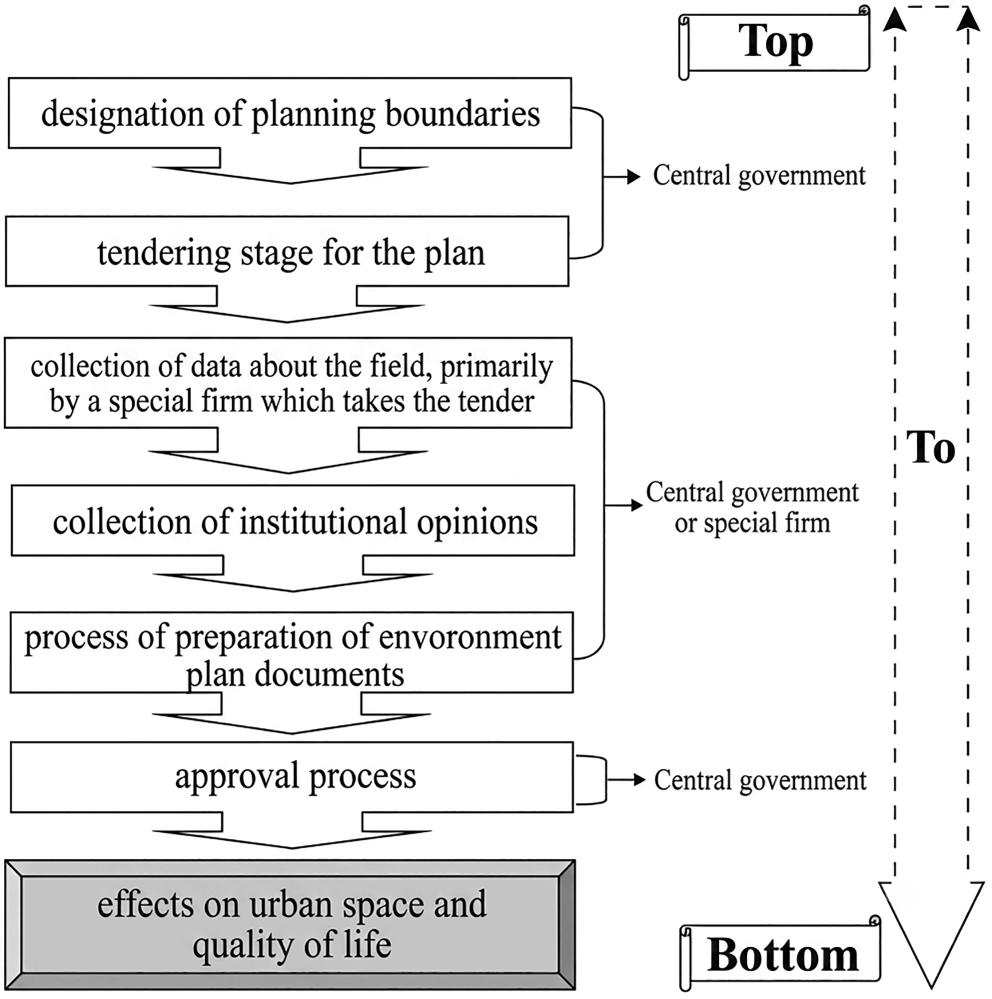
A related administrative issue concerns the position of the Environmental Plan within the planning hierarchy. In many European contexts, upper-scale planning is organized through a clearer relationship between regional planning and lower-scale urban plans (Ercoşkun 2005). In Türkiye, however, the Environmental Plan adds a highly prescriptive layer between regional frameworks and lower-scale statutory plans, reinforcing vertical hierarchy rather than coordination across planning levels.
A second cluster of contradictions concerns scale. The 2004 Metropolitan Municipality Law authorized metropolitan municipalities to prepare master plans at scales from 1/5,000 to 1/25,000, provided that they were compatible with existing Environmental Plans. This expanded the scale of master plans and created two problems: it blurred the distinction between 1/25,000-scale and conventional 1/5,000-scale master plans, and generated overlap between 1/25,000-scale master plans and previously approved Environmental Plans at the same scale (Ersoy 2006).
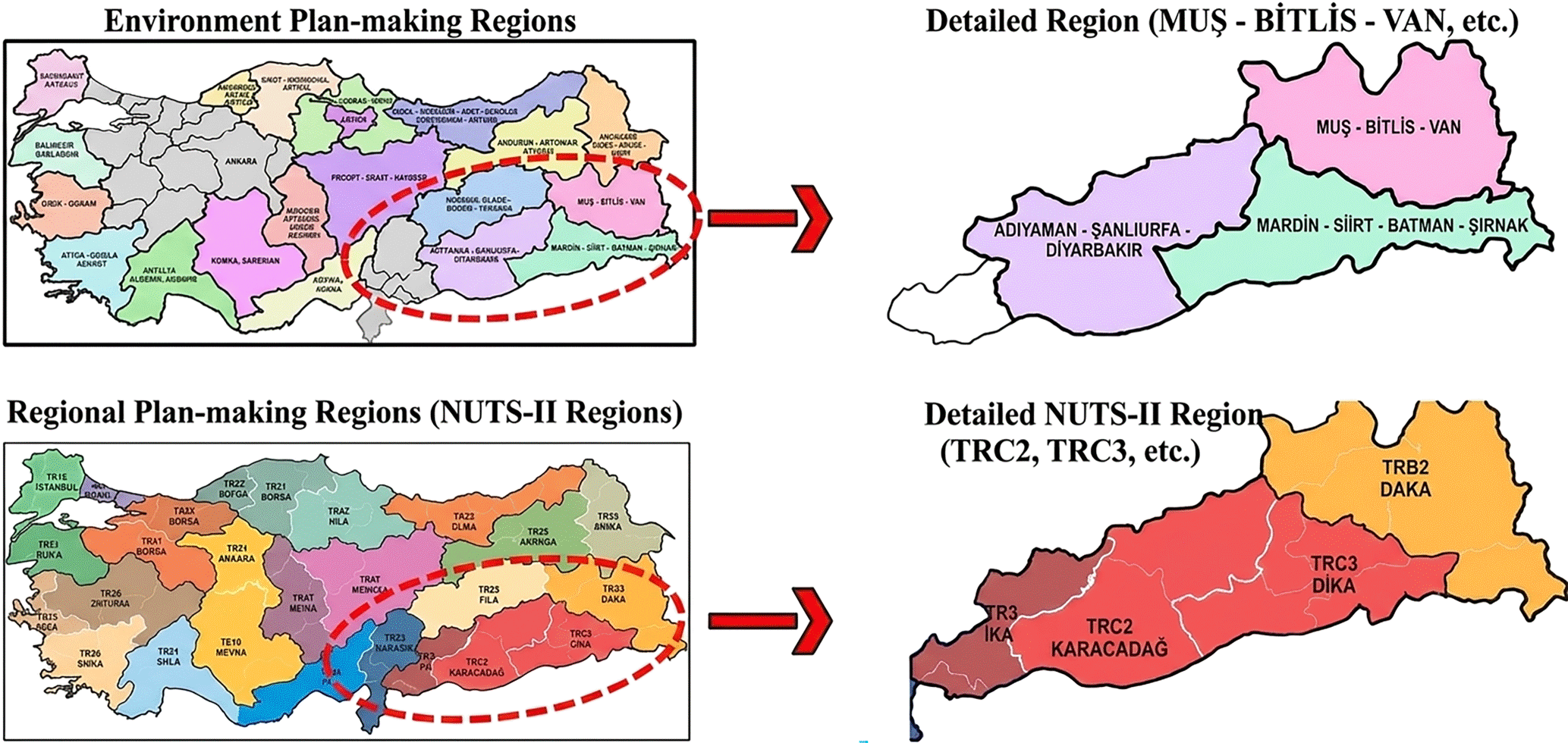
Although later amendments attempted to resolve this confusion by redefining Environmental Plan scales, scalar ambiguity persisted. Previously approved 1/25,000-scale Environmental Plans continued to overlap in territorial coverage and policy content, while inconsistencies remained between the relevant law and planning regulations. The Environment Law defined Environmental Plans mainly at 1/50,000 and 1/100,000 scales, whereas the Regulation on the Principles of Plan Making continued to allow 1/25,000, 1/50,000, 1/100,000, and 1/200,000 scales. Despite the formal hierarchy of norms, this discrepancy has continued to create uncertainty over the plan’s appropriate scale, content, and territorial scope. Scalar problems therefore cannot be resolved through piecemeal legislative adjustment alone.
Authority conflicts further deepen these administrative and scalar contradictions. Before the 2011 institutional reorganization, responsibility for Environmental Plans was divided between different ministries, particularly the former Ministries of Public Works and Settlement and Environment and Forestry. Although the establishment of the Ministry of Environment and Urban Planning partly consolidated authority, it did not eliminate inter-institutional tensions. The 5302 Special Provincial Administration Law introduced the Provincial Environmental Plan, adding a new planning layer under the provincial administrations and creating concerns over overlapping boundaries, competing mandates, inconsistent plan proposals, and implementation difficulties caused by weak coordination.
Later legal changes limited Provincial Environmental Plans to provincial boundaries, while areas extending beyond a single province remained under ministerial authority. Yet this did not prevent different upper-scale plans applying to the same territory under different institutional arrangements. As a result, the Environmental Plan remains embedded in a fragmented administrative landscape where formal hierarchy does not necessarily ensure effective territorial coordination.
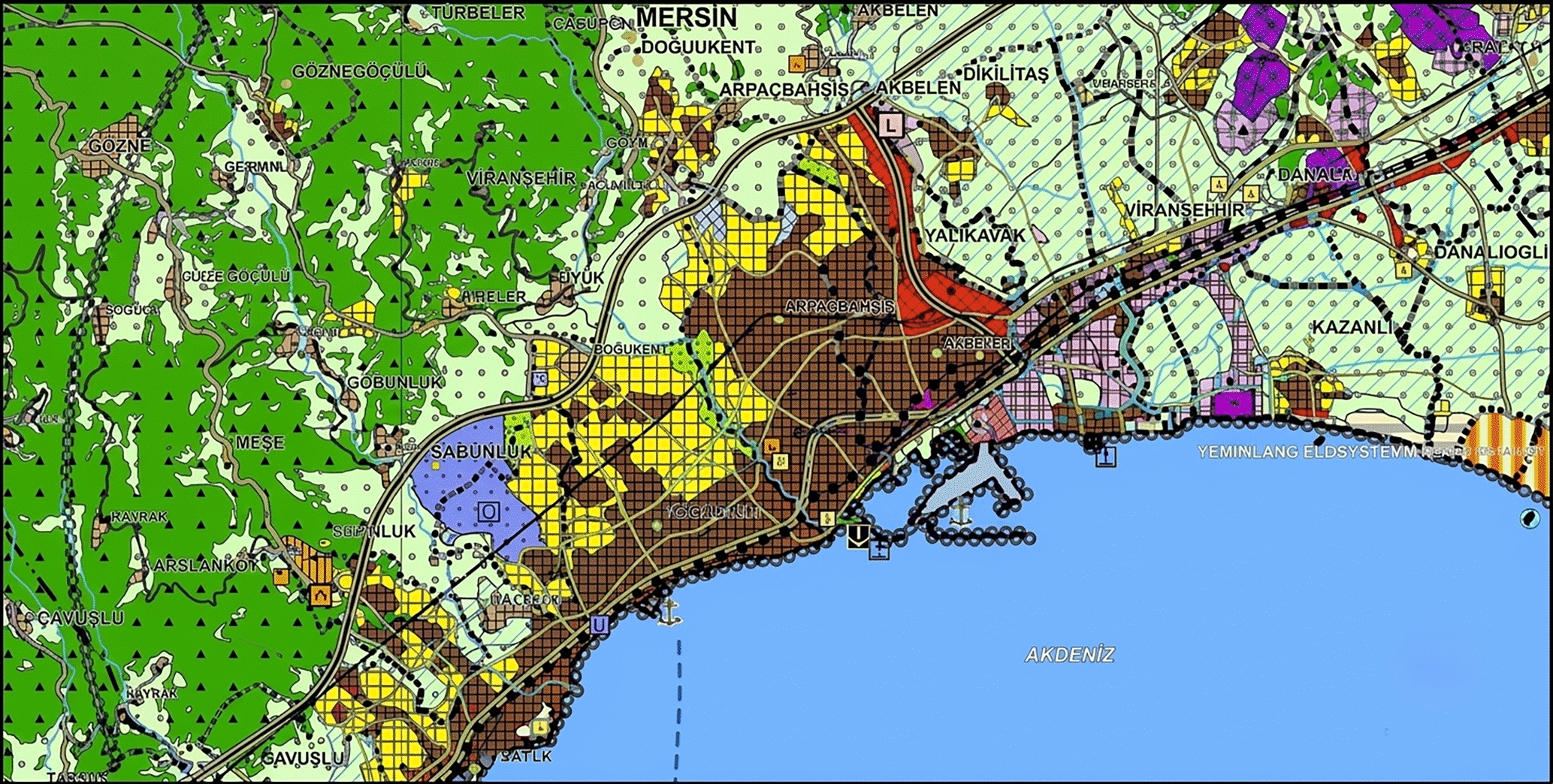
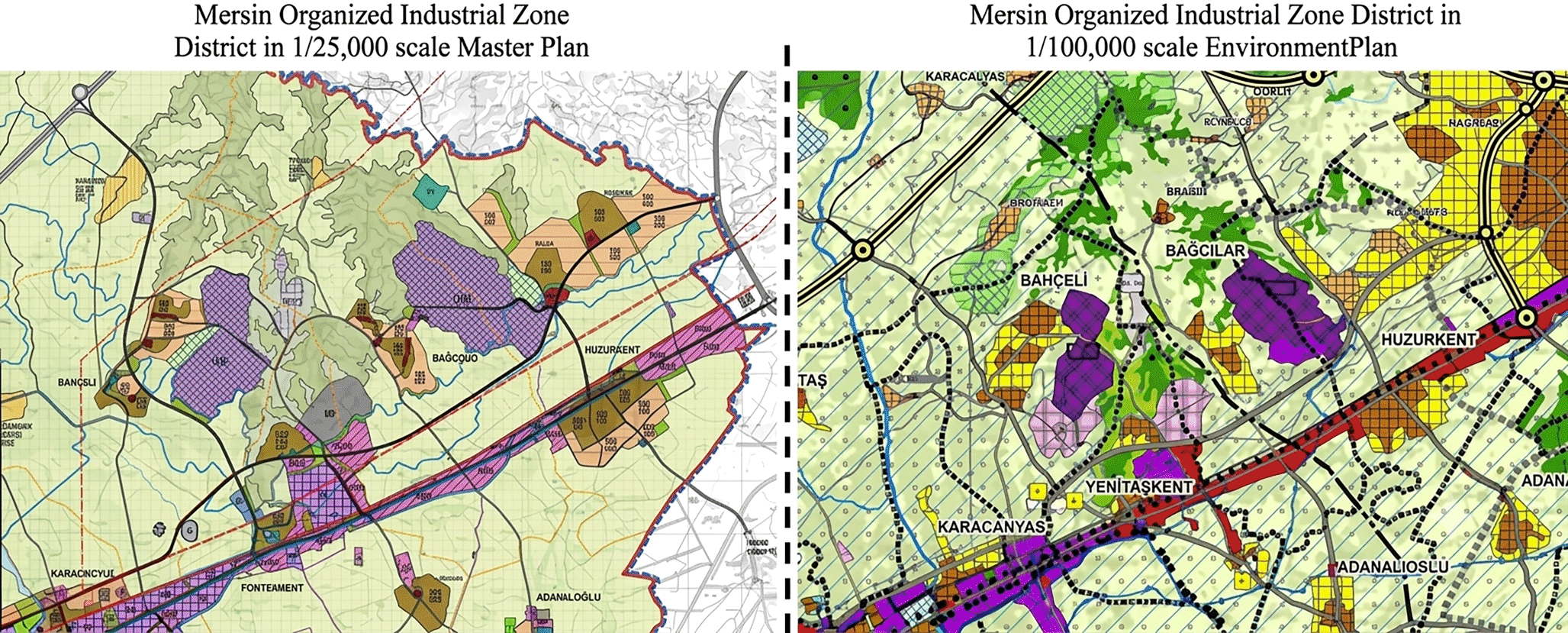
The final structural contradiction concerns the weak strategic content of the Environmental Plan. In practice, the plan often fails to provide a strategic framework, functioning rather as a repository of data compiled from the field, including infrastructure information, land-use inventories, photographs, and institutional records. While such data are necessary for plan preparation, they do not in themselves constitute strategic planning. An effective upper-scale plan should define priorities, development corridors, policy directions, and territorial choices. When Environmental Plans become primarily descriptive or inventory-based documents, their capacity to guide long-term spatial transformation remains limited.
Overall, these administrative, scalar, and structural contradictions suggest that the Environmental Plan, in its current form, cannot fully respond to the requirements of contemporary upper-scale planning in Türkiye. It is spatially influential, yet institutionally fragmented, overly rigid, and strategically weak. However, identifying the limitations of the Environmental Plan is insufficient to provide a complete alternative. The next section therefore turns to the second major upper-scale instrument in Türkiye – the Strategic Plan – in order to examine a different but complementary deficiency: the presence of strategy without an adequate spatial framework.
In Türkiye, local governments are authorized to prepare Strategic Plans to guide public action and respond to urban needs. In practice, however, municipalities face increasingly diverse service demands under limited financial and institutional capacity (Emrealp/Yıldırım 1993). This makes strategic spatial planning particularly relevant, as it offers a framework for addressing rapid urbanization, technological and social change, migration, infrastructure deficits, growing urban problems, rising service expectations, and the need for sustainable long-term local decision-making (Akın/Güleç 2003). Although Türkiye has incorporated some elements of this broader approach, two key problems remain: the weak spatial dimension of the Strategic Plan and insufficient coordination among planning actors.
The main limitation of the Strategic Plan in Türkiye is substantive rather than merely terminological. Although expected to guide urban development, it is not formulated as a genuinely spatial planning instrument. The relationship between vision, policy, and strategy, on the one hand, and urban space, on the other, remains weak. Instead of producing spatial frameworks through schematic representations, strategic policy areas, development corridors, or territorially differentiated priorities, Strategic Plans tend to focus on institutional visions, policy statements, objectives, and project lists. As a result, they provide limited guidance on how these decisions should shape the spatial structure of the city or region.
This weak spatial dimension also explains why many Strategic Plans in Türkiye resemble one another. As mainly textual and administrative documents, they often converge around similar formulations of vision, mission, and policy language. A stronger spatial framework, by contrast, would make them more differentiated, place specific, and implementable. If Strategic Plans are to function as genuine upper-scale planning tools, they should therefore incorporate clearer spatial content, development patterns, and territorially grounded proposals. The institutional and methodological principles of such a Strategic Spatial Plan should also be more clearly defined (Beyhan 2009). This would require that planning expertise play a stronger role, since spatial strategies depend on planners’ ability to translate goals, priorities, and sectoral decisions into territorial frameworks.
A second problem concerns coordination and implementation capacity. Coordination among stakeholders is essential to Strategic Spatial Planning, because strategic priorities gain legitimacy and practical force only through effective participation. Broad involvement by citizens, institutions, and relevant actors can prevent the Strategic Plan from remaining a narrowly institutional document and help it reflect a shared territorial agenda. However, in Türkiye, Strategic Plans suffer from weak coordination across institutions and planning levels. They are prepared separately by different local administrative bodies, especially municipalities and special provincial administrations. Rather than producing a single strategic framework for a shared territory, this fragmented structure may generate multiple Strategic Plans for the same area. Such institutional disconnectedness weakens policy coherence, reduces collective ownership, and creates implementation difficulties. A more effective strategic spatial planning framework would therefore require stronger coordination, joint ownership, and a more integrated participatory process across institutions.
The previous analysis shows that Türkiye’s upper-scale planning system is shaped by two incomplete instruments. While the Environmental Plan provides spatial direction but remains rigid, hierarchical, and strategically weak, the Strategic Plan introduces vision and policy orientation but lacks an adequate spatial framework and effective coordination capacity. This dual deficiency suggests the need for a new planning model that does not simply reproduce either instrument but rather integrates their missing dimensions within a more coherent strategic spatial planning approach.
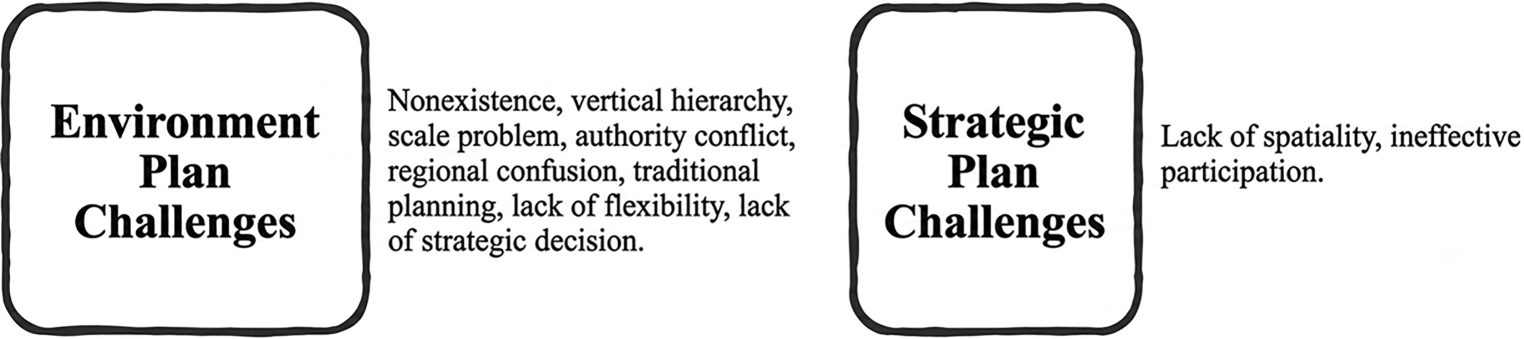
More broadly, the current planning perspective in Türkiye can be criticized for being overly technical, for privileging the physical dimension of development over its social and institutional dimensions, for often remaining at the level of formal documentation without sufficient implementation capacity, and for responding inadequately to the changing conditions of contemporary urbanization. In this context, strategic spatial planning has gained importance as a more flexible and adaptive approach capable of linking long-term orientation, spatial guidance, governance, and implementation (Genç 2008).
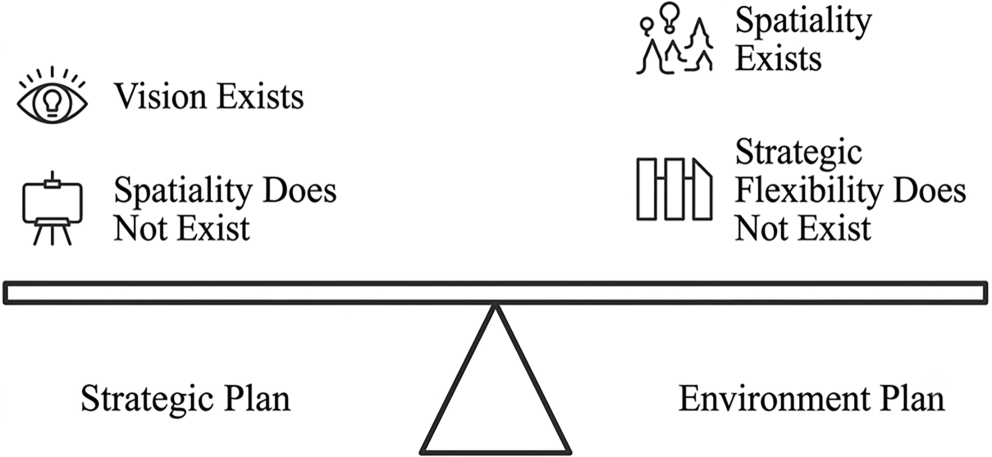
This situation highlights the need for a new planning model. Such a model should not be understood as a mechanical combination of the existing Strategic Plan and Environmental Plan. Rather, it should selectively integrate their strengths while avoiding their established weaknesses. Hence the new model should retain the action-oriented policy framework, future-oriented vision, and non-hierarchical governance potential of the Strategic Plan. And it should retain a transformed and more flexible spatial dimension capable of guiding territorial development without reproducing rigid land-use determinism from the Environmental Plan. In addition, unlike both earlier models, the new framework should be based on a much stronger participatory structure involving citizens, institutions, and other stakeholders throughout the planning process.
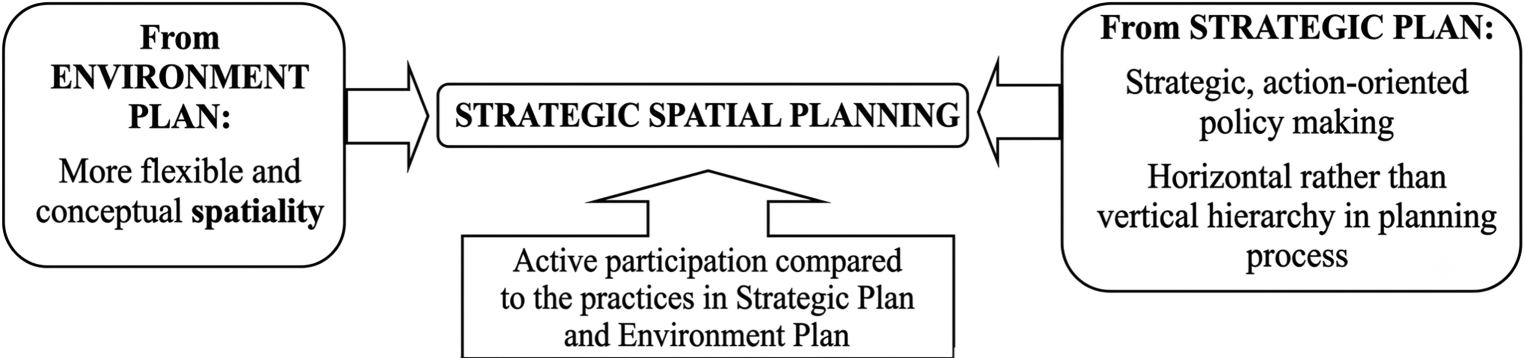
A defining characteristic of the proposed model is its reliance on bottom-up participation and horizontal coordination rather than top-down hierarchical control. As discussed earlier, one of the main weaknesses of the Environmental Plan is the dominance of central authority and the limited role of participation in plan making. The proposed Strategic Spatial Plan should therefore be prepared using a governance-based process led by local governments and structured around the active involvement of multiple actors including citizens, civil society organizations, central administrative bodies, and private-sector representatives. The model thereby reflects the broader transition from government to governance in contemporary planning.
Such an approach would also strengthen institutional cooperation, which remains weak in both Environmental Plan and Strategic Plan practices in Türkiye. At present, planning processes are often fragmented across institutions that operate separately or even competitively. Rather than producing separate plans through disconnected administrative channels, the proposed model would establish a single integrated Strategic Spatial Plan for a clearly defined territory, prepared through cooperation across different institutional levels. This would increase collective ownership of the plan while improving its coherence and implementation capacity. In this respect, the proposed model aligns with co-production approaches to public governance, which understand planning not as an expert-led technical product but as a collectively owned process shaped by sustained interaction among citizens, institutions, and other stakeholders (Ostrom 1996; Voorberg/Bekkers/Tummers 2015).
The territorial scope of the plan should also be handled more flexibly than in current practice. Rather than being determined solely through rigid administrative boundaries, the planning area should be defined in relation to functional, regional, and strategic considerations. At the same time, the decisions of Regional Plans should be taken into account within this collaborative framework so that the new model can strengthen vertical coordination without reproducing rigid hierarchies.
In Türkiye, upper-scale planning is currently polarized between two inadequate instruments: rigid spatial plans on the one hand and non-spatial written strategy documents on the other. The proposed Strategic Spatial Plan should be positioned between these two extremes. Unlike the Environmental Plan, it should not prescribe lower-scale land-use decisions or unnecessarily constrain subsequent plans. At the same time, unlike the existing Strategic Plan, it should not remain limited to textual statements of vision, policy, and projects without territorial expression.
For this reason, the new model should incorporate an abstract, conceptual, and flexible spatial framework. Its role should be to identify and guide strategic development corridors, priority development areas, conservation zones, sectoral development patterns, infrastructure orientations, and interregional or international connections, rather than to reproduce detailed land-use allocations. Such a representational logic would allow upper-scale planning to provide spatial direction while preserving the flexibility required for lower-scale interpretation and implementation. The international strategic spatial-planning literature also supports this kind of schematic and policy-oriented spatial representation.
The effectiveness of such a framework depends in part on the stronger integration of planning expertise into the strategic planning process. A meaningful spatial strategy cannot emerge solely from administrative negotiation or political agreement. It also requires the analytical and synthetic capacities of qualified planners who are able to interpret the territory as a whole and translate strategic priorities into spatial form. For this reason, the role of urban planners should be strengthened in the preparation of the new model.
Ultimately, the importance of spatiality lies in its relationship to implementation. Plans cannot shape territorial development unless policies, priorities, and strategies are connected to space in an intelligible way. A strategic framework without spatial expression remains difficult to operationalize, while a spatial framework without flexibility becomes restrictive and ineffective. The proposed model therefore treats spatial representation not as a graphic supplement to strategy, but as one of the main conditions for implementation.
As Oliveira and Hersperger (2019) emphasize, plan making is not merely a technical preparatory stage, but a governance practice shaped by negotiations among actors across multiple institutional levels – a point particularly relevant for Türkiye, where the question is not only what kind of plan is produced but through which institutional arrangements it is formed. The Turkish case thereby confirms a core Strategic Spatial Planning insight: the effectiveness of upper-scale planning depends on alignment between spatial content, governance configuration, and implementation capacity. The limitations of both Environmental Plans and Strategic Plans are not isolated technical defects but reflect a deeper fragmentation between planning rationalities. The former retain spatial reach through rigid land-use logic, the latter introduce vision and policy orientation while remaining weak in territorial articulation. The result is not two complementary instruments but two incomplete ones, each embodying different dimensions of Strategic Spatial Planning without integrating them into a coherent framework.
Comparable tensions between strategic and statutory instruments appear in other contexts: between Regional Spatial Strategies and Local Development Frameworks in the UK (Gallent 2008; Baker/Hincks/Sherriff 2010), and between the Piano Strutturale and Piano Operativo in Italy (Scattoni/Falco 2011; Cotella 2022). The Turkish case differs, however. In the former contexts, the issue concerns coherence between components within a single planning system, whereas in Türkiye strategic capacity and spatial/regulatory capacity have been institutionally allocated to different instruments from the outset.
These findings have two implications for the broader Strategic Spatial Planning literature. First, they support arguments that Strategic Spatial Planning should be understood as more than a softer version of statutory land-use planning. It rather involves vision making, selectivity, governance, and the capacity to connect strategy to territory and implementation. The Turkish case extends this debate by showing that fragmentation may emerge not only from institutional complexity within a single planning system, but also from the coexistence of separate plan types that divide strategy and spatiality between them. Second, the findings speak to discussions on governance culture and planning context. As Allin and Walsh (2010) argue, planning systems cannot be interpreted adequately through legal or instrumental classifications alone; they must also be understood in relation to governance cultures, institutional capacity, and socio-spatial conditions. The limitations of Environmental Plans are not reducible to scale or legal definitions; they are tied to centralization, weak participation, and fragmented authority. Equally, the non-spatial character of Strategic Plans reflects an administrative reform context in which strategic planning was institutionalized primarily as a managerial instrument. The limits of upper-scale planning in Türkiye are thus embedded in the broader institutional design of the planning system, rather than in the formal properties of individual plans.
The proposed Strategic Spatial Planning model should therefore be read not as a simple synthesis of two existing plans, but as an attempt to overcome the structural separation between strategy and spatiality in Turkish upper-scale planning. Its main contribution lies in reassembling elements that the Strategic Spatial Planning literature usually treats as inseparable: territorial vision, spatial representation, governance-based plan making, and implementation-oriented selectivity. In this respect, the model aligns with the core claims of Strategic Spatial Planning while also responding to a context-specific institutional fragmentation that has received limited attention in the literature. The Turkish case suggests that in planning systems where strategic and spatial functions are split between different instruments, the key challenge is not merely reforming one type of plan, but redesigning the relationship between instruments, actors, and scales.
At the same time, this discussion has broader implications. The Turkish experience indicates that the transition from hierarchy to governance in planning cannot be achieved solely by introducing new planning terminology or additional plan types. Without spatial articulation, strategic planning remains weak in territorial effect; without flexibility, participation, and institutional coordination, spatial planning remains regulatory rather than strategic. The broader lesson is that Strategic Spatial Planning should be evaluated not only according to the presence of visions, maps, or participatory rhetoric, but by the extent to which these dimensions are institutionally integrated within a workable upper-scale planning framework.
This paper has argued that the main problem of upper-scale planning in Türkiye is not simply the weakness of a single planning instrument, but the fragmentation of strategic and spatial capacities across two different plan types. Environmental Plans continue to provide the principal upper-scale spatial framework, yet they do so through a rigid, hierarchical, and weakly strategic logic. Strategic Plans, by contrast, introduce vision, priorities, and policy orientation, but remain largely non-spatial and institutionally limited in their ability to guide territorial development. The central conclusion of the paper is therefore that upper-scale planning in Türkiye is divided between space without strategy and strategy without space, and that neither instrument can, on its own, respond adequately to contemporary planning challenges.
The proposed model must, however, be situated within the political and institutional conditions that currently shape planning in Türkiye. It cannot be assumed that the shift from government to governance that underpins the model will emerge organically in a context characterized by a centralized administrative tradition and increasing concentration of executive authority, particularly following the 2018 transition to a presidential system. As research on urban governance in Türkiye suggests, the formal centralization of planning authority has at times coexisted with the informal influence of various institutional and private-sector interests over local land-use decisions. This dynamic indicates the importance of designing participatory arrangements with explicit attention to how different actors are positioned within the process. As Elliott (2026) cautions more broadly, participatory governance mechanisms do not automatically translate into meaningful inclusion. Without explicit attention to how power is distributed among actors, participatory rhetoric may lend legitimacy to processes that remain substantively exclusive. The proposed model should therefore be read not as a description of current institutional conditions in Türkiye, but as a normative framework that identifies what an integrated upper-scale planning approach would require – and, by extension, what structural and political conditions would need to change for such an approach to become operative.
On this basis, the paper has proposed that the future of upper-scale planning in Türkiye should lie not in preserving this dual structure or privileging one plan type over the other. Instead, it requires a Strategic Spatial Planning model that selectively integrates strategic vision, spatial articulation, participatory governance, and implementation capacity within a single framework. The proposed model is therefore not a mechanical merger of existing Strategic Plans and Environmental Plans, but an attempt to overcome their separation by reconnecting what is currently divided between them: policy orientation, territorial guidance, institutional coordination, and flexibility.
A related question concerns how an integrated upper-scale framework would connect to development control at the local level. In Türkiye, upper-scale instruments guide Master Plan preparation (Nazım İmar Planları, 1/5,000–1/25,000), which in turn informs local Implementation Plans (Uygulama İmar Planları, 1/1,000). The proposed model would operate through this existing order. A strategically coherent upper-scale framework would provide clearer orientation for Master Plans, reducing the discretionary gaps that currently allow local plans to diverge from upper-scale intentions, but would also avoid prescribing local solutions from above.
The findings are particularly relevant for planning systems where strategic and spatial functions have developed along separate institutional tracks – a condition that extends beyond Türkiye and is observable in other contexts where public administration reform and statutory spatial planning have evolved independently of one another. More broadly, the Turkish case demonstrates that the central challenge of contemporary upper-scale planning is not simply to produce better plans, but to integrate strategy, space, governance, and implementation within a coherent institutional framework. In the Turkish context, this integration would operate through the existing planning order, connecting upper-scale frameworks to local development control via Master and Implementation Plans. The paper hence contributes to spatial planning scholarship by identifying a form of fragmentation that remains underexplored in the Strategic Spatial Planning literature: the separation of strategic and spatial capacities across different planning instruments. This insight opens the way for further comparative research on how such fragmentation operates in other national and regional planning systems, how it affects territorial governance and implementation, and under what institutional conditions more integrated upper-scale planning models can emerge. The paper thus aims to contribute not only to debates on planning reform in Türkiye, but also to a wider understanding of how strategic spatial planning can be conceptualized, evaluated, and redesigned in contexts marked by institutional complexity.
References
| Akın, B.; Güleç, S. (2003): Belediyelerde Stratejik Planlamanın Gerçekleştirilebilirliği ve Karaman Belediyesiʼnde Gerçekleştirilen Bir Analiz. In: TODAİE – Türkiye ve Orta Doğu Amme İdaresi Enstitüsü (ed.): Kamu Yönetiminde Kalite. 3. Ulusal Kongresi. Ankara, 429–445. = TODAİE Yayınları 319. |
| Albrechts, L. (2001): From traditional land use planning to strategic spatial planning: The case of Flanders. In: Albrechts, L.; Alden, J.; da Rosa Pires, A. (eds.): The changing institutional landscape of planning. Aldershot, 83–112. |
| Albrechts, L. (2004): Strategic (spatial) planning reexamined. In: Environment and Planning B: Urban Analytics and City Science 31, 5, 743–758. https://doi.org/10.1068/b3065 |
| Albrechts, L. (2005): Strategic (spatial) planning revisited. In: Ertekin, Ö. (ed.): Planlamada Yeni Politika ve Stratejiler. Riskler ve Fırsatlar. 7–9 Kasım 2005. İstanbul, xxv–xliii. = 8 Kasım Dünya Şehircilik Günü 29. |
| Albrechts, L. (2010): More of the same is not enough! How Could Strategic Spatial Planning be Instrumental in Dealing with the Challenges Ahead? In: Environment and Planning B: Urban Analytics and City Science 37, 6, 1115–1127. https://doi.org/10.1068/b36068 |
| Allin, S.; Walsh, C. (2010): Strategic spatial planning in European city-regions: Parallel processes or divergent trajectories? Maynooth. = NIRSA Working Paper Series 60). |
| Ataöv, A.; Eraydın, A. (2011): Different forms of governance: Responses of two metropolitan regions in Turkey to state restructuring. In: Urban Affairs Review 47, 1, 84–128. https://doi.org/10.1177/1078087410372608 |
| Baker, M.; Hincks, S.; Sherriff, G. (2010): Getting involved in plan making: Participation and stakeholder involvement in local and regional spatial strategies in England. In: Environment and Planning C: Politics and Space 28, 4, 574–594. https://doi.org/10.1068/c0972 |
| Balaban, O. (2012): The negative effects of construction boom on urban planning and environment in Turkey: Unraveling the role of the public sector. In: Habitat International 36, 1, 26–35. https://doi.org/10.1016/j.habitatint.2011.05.003 |
| Beyhan, B. (2009): Üst Ölçek Planların İzlenmesi ve Değerlendirilmesi Üzerine: Kentsel ve Bölgesel Gözlemevlerinin Gerekliliği. In: TEPAV – Türkiye Ekonomi Politikaları Araştırma Vakfı (ed.): 3. Bölgesel Kalkınma ve Yönetişim Sempozyumu. „Planlamadan Uygulamaya“. 27–28 Kasım 2008, Mersin. Bildiri Kitabi. Ankara, 133–203. = TEPAV Yayınları 45. |
| Blotevogel, H.H. (2000): Rationality and Discourse in (Post)Modern Spatial Planning. In: The Revival of Strategic Spatial Planning. [Proceedings of the Colloquium, Amsterdam 25-26 February 1999]. Amsterdam, 121–134. = Verhandelingen der Koninklijke Nederlandse Akademie der Wetenschappen, Afd. Letterkunde, N.R. 181. |
| Cotella, G. (2022): The planning system in Italy and how it addresses tourism-related issues. In: Napierala, T.; Lesniewska-Napierala, K.; Cotella, G. (eds.): Contemporary Challenges of Spatial Planning in Tourism Destinations. Lodz, 13–36. https://doi.org/10.18778/8331-149-4.02 |
| Cremer-Schulte, D. (2014): With or without you? Strategic spatial planning and territorial re-scaling in Grenoble urban region. In: Planning Practice and Research 29, 3, 287–301. https://doi.org/10.1080/02697459.2014.929844 |
| Duyguluer, F. (2005): Ankara Planlari Baǧlaminda Mücavir Alan Kavram ve Uygulamasi. In: Şenyapılı, T. (ed.): Cumhuriyet’in ‘Ankara’sı. Ankara, 154–171. |
| Elliott, K.J. (2026): Participatory democracy and its limits. In: Annual Review of Political Science 29, 329–347. https://doi.org/10.1146/annurev-polisci-032724-125408 |
| Emrealp, S.; Yıldırım, S. (1993): Yerel Yönetimde Başarının Yolları. İstanbul. = Yerel Yönetimin Geliştirilmesi Programı El Kitapları Dizisi 1. |
| Ercoşkun, Ö.Y. (2005): Kent Planlama Sistemleri Üzerine Bir Karşılaştırma: Avrupa Ülkeleri ve Türkiye. In: Çalgüner, T. (ed.): Şehircilik Çalışmaları. Ankara, 85–104. |
| Ersoy, M. (2006): İmar Mevzuatımızda Planlama Kademeleri ve Üst Ölçek Planlama Sorunu. In: ODTÜ – Orta Doğu Teknik Üniversitesi, Mimarlık Fakültesi; TEPAV – Türkiye Ekonomi Politikaları Araştırma Vakfı (eds.): Bölgesel Kalkınma ve Yönetişim Sempozyumu. 7–8 Eylül, 2006. Ankara, 215–231. |
| Fainstein, S.S. (2010): The just city. Ithaca. |
| Faludi, A. (2000): The performance of spatial planning. In: Planning Practice and Research 15, 4, 299–318. https://doi.org/10.1080/713691907 |
| Gallent, N. (2008): Strategic-local tensions and the spatial planning approach in England. In: Planning Theory and Practice 9, 3, 307–323. https://doi.org/10.1080/14649350802277795 |
| Gedikli, B. (2007): Stratejik mekansal planlama: Planlamada yeni anlayışlar, yöntemler, teknikler. In: Ersoy, M. (ed.): Kentsel planlama kuramları. Ankara, 229–278. |
| Gedikli, B. (2010): Examination of the interpretation of strategic spatial planning in three cases from Türkiye. In: European Planning Studies 18, 2, 281–297. https://doi.org/10.1080/09654310903491481 |
| Genç, F.N. (2008): Planlama Paradigmalarında Değişim Çerçevesinde Türkiye’de Stratejik Planlama. In: TMMOB Şehir Plancıları Odası (ed.): Planlama Meslek Alanı: Geçmişten geleceğe. Ankara, 7–8–9 Kasım 2007. Bildiriler Kitabı. Ankara, 417–433. = 8 Kasım Dünya Şehircilik Günü 31. |
| Healey, P. (1996): The communicative turn in planning theory and its implications for spatial strategy formation. In: Environment and Planning B: Urban Analytics and City Science 23, 2, 217–234. https://doi.org/10.1068/b230217 |
| Healey, P. (1997): Collaborative planning: Shaping places in fragmented societies. London. |
| Healey, P. (2007): Urban complexity and spatial strategies: A relational planning for our times. London. |
| Healey, P. (2009): In search of the “strategic” in spatial strategy making. In: Planning Theory and Practice 10, 4, 439–457. https://doi.org/10.1080/14649350903417191 |
| Hersperger, A.M.; Grădinaru, S.; Oliveira, E.; Pagliarin, S.; Palka, G. (2019): Understanding strategic spatial planning to effectively guide development of urban regions. In: Cities 94, 96–105. https://doi.org/10.1016/j.cities.2019.05.032 |
| Hopkins, L.D. (2001): Urban development: The logic of making plans. Washington, DC. |
| Hossu, C.-A. Oliveira, E.; Niță, A. (2022): Streamline democratic values in planning systems: A study of participatory practices in European strategic spatial planning. In: Habitat International 129, 102675. https://doi.org/10.1016/j.habitatint.2022.102675 |
| Hutter, G.; Wiechmann, T. (2022): Time, temporality, and planning: Comments on the state of art in strategic spatial planning research. In: Planning Theory and Practice 23, 1, 157–164. https://doi.org/10.1080/14649357.2021.2008172 |
| Kayasü, S.; Yetişkul, E. (2014): Evolving legal and institutional frameworks of neoliberal urban policies in Turkey. In: METU Journal of the Faculty of Architecture 31, 2, 209–222. https://doi.org/10.4305/METU.JFA.2014.2.11 |
| Kuyucu, T.; Ünsal, Ö. (2010): “Urban transformation” as state-led property transfer: An analysis of two cases of urban renewal in Istanbul. In: Urban Studies 47, 7, 1479–1499. https://doi.org/10.1177/0042098009353629 |
| Nadin, V.; Stead, D. (2013): Opening up the compendium: An evaluation of international comparative planning research methodologies. In: European Planning Studies 21, 10, 1542–1561. https://doi.org/10.1080/09654313.2012.722958 |
| Oittinen, J.; Mäntysalo, R. (2024): Enabling multiple outcomes: Strategic spatial planning in a shrinking city-region. In: Urban Planning 9. https://doi.org/10.17645/up.7694 |
| Olesen, K. (2023): Reviving strategic spatial planning for the challenges ahead. In: European Planning Studies 31, 11, 2318–2326. https://doi.org/10.1080/09654313.2023.2231500 |
| Oliveira, E.; Hersperger, A.M. (2019): Disentangling the governance configurations of strategic spatial plan-making in European urban regions. In: Planning Practice and Research 34, 1, 47–61. https://doi.org/10.1080/02697459.2018.1548218 |
| Ostrom, E. (1996): Crossing the great divide: Coproduction, synergy, and development. In: World Development 24, 6, 1073–1087. https://doi.org/10.1016/0305-750X(96)00023-X |
| Özcan, G.B. (2000): Local economic development, decentralization and consensus building in Türkiye. In: Progress in Planning 54, 4, 199–278. https://doi.org/10.1016/S0305-9006(00)00018-0 |
| Ozdemir, Y.; Gul, M. (2019): Measuring development levels of NUTS‑2 regions in Turkey based on capabilities approach and multi-criteria decision-making. In: Computers and Industrial Engineering 128, 150–169. https://doi.org/10.1016/j.cie.2018.12.035 |
| Palakodeti, A.K. (2020): Spatial planning is beyond traditional land-use planning? A critical review. In: International Journal of Science and Research 9, 8, 808–811. https://doi.org/10.21275/SR20813212700 |
| Phelps, N.A.; Valler, D.C. (2024): ‘What planners don’t do is plan’: Recovering the English strategic spatial planning imagination. In: Planning Practice and Research 39, 5, 876–891. https://doi.org/10.1080/02697459.2024.2385227 |
| Polat, E. (2011): Planlamada Altı-İzli Yeni ve Esnek Bir Paradigma: Stratejik Mekânsal Planlama. In: Hazırlayanlar, Y. (ed.): Planlamanın Dünü, Bugünü, Yarını. Planlamada Yeni Söylem Arayışları. 2. Kentsel ve Bölgesel Araştırmalar Sempozyumu, 8–9 Aralık 2011 Ankara. Bildiri Kitabı. Ankara, 51–61. |
| Sartorio, F.S. (2005): Strategic spatial planning: A historical review of approaches, its recent revival, and an overview of the state of the art in Italy. In: disP – The Planning Review 162, 3, 26–40. https://doi.org/10.1080/02513625.2005.10556930 |
| Savini, F. (2025): Strategic planning for degrowth: What, who, how. In: Planning Theory 24, 2, 141–162. https://doi.org/10.1177/14730952241258693 |
| Scattoni, P.; Falco, E. (2011): Why Italian planning is worth studying. In: Italian Journal of Planning Practice 1, 1, 4–32. |
| Şengül, H.T. (2009): Kentsel çelişki ve siyaset: Kapitalist kentleşme süreçlerinin bir eleştirisi. Ankara. |
| Taylor, N. (2010): Urban planning theory since 1945. London. |
| Tekeli, İ. (1990): Kent Planlaması ve Katılım Üzerine Düşünceler. In: Planlama 90, 3‑4, 8–13. |
| Trygg, K.; Grundel, I. (2025). Strategic spatial planning in the implementation of mobility hubs. In: Journal of Urban Mobility 7, 1001015. https://doi.org/10.1016/j.urbmob.2025.100105 |
| UN-Habitat – United Nations Human Settlements Programme (2015): International Guidelines on Urban and Territorial Planning. Handbook. Nairobi. |
| Voorberg, W.H.; Bekkers, V.; Tummers, L.G. (2015): A systematic review of co-creation and co-production. Embarking on the social innovation journey. In: Public Management Review 17, 9, 1333–1357. https://doi.org/10.1080/14719037.2014.930505 |
| Yüksel, F.; Bramwell, B.; Yüksel, A. (2005): Centralized and decentralized tourism governance in Türkiye. In: Annals of Tourism Research 32, 4, 859–886. https://doi.org/10.1016/j.annals.2004.09.006 |
Footnotes
| 1 | An earlier conference-paper version of this study was presented as “‘Strategic Plan’ and ‘Environment Plan’ in Turkey in the Context of a Question: Can ‘Environment Plan’ Be Combined to ‘Strategic Plan’ to Get a New Planning Type Named ‘Strategic Spatial Planning’ in Turkey?”, at the 26th AESOP Annual Congress, Ankara, 11–15 July 2012. The present paper substantially develops the initial argument of that conference paper. While retaining its original concern with the separation between the non-spatial Strategic Plan and the rigidly spatial Environmental Plan, the paper reformulates this issue as an institutional and conceptual fragmentation of strategic and spatial capacities across two different planning instruments. It also introduces an explicit qualitative document-analysis design and a systematic comparison based on spatial content, governance logic, scalar positioning, and implementation capacity, updates the relevant scholarly, legal, and institutional context, including post-2012 transformations in Türkiye’s planning and governance system, and expands the original discussion through comparative, governance-oriented, and implementation-focused analysis. The present paper should therefore be understood as a substantially revised, updated, and extended journal version of the 2012 conference paper. |