
With the ever-increasing importance of sustainable development and the goal of limiting the use of previously undeveloped land in “no net land take” (Adrian/Bock/Bunzel et al. 2018: 10; European Commision 2021: 3), the development of existing urban areas is becoming increasingly important. Additionally, cities must adapt their existing urban environments in response to structural socio-demographic, socio-economic and climate change. Over the past decades, this redevelopment of the city has become a prominent concern in Germany and across Europe. Since the 1990s, globalisation and economic structural change have led to large-scale conversion areas, including former barracks and industrial sites (Lütke Daldrup/Zlonicky 2009). For these and similar large-scale projects, a development plan (Bebauungsplan1) is typically created or an existing plan amended. At the same time, there is growing attention being directed towards more fine-grained approaches and smaller-scale developments within existing urban structures (e.g., Ernst Basler + Partner 2013; Blum/Atci/Roscher et al. 2022; Förster/Karow-Kluge/Weber et al. 2025).
This paper investigates the role of planning law in these small-scale developments in Germany. A substantial portion of settlement structures in Germany are covered by valid development plans. For example, in Nuremberg, approximately 30 to 40 % of housing development occurs in areas with a pre-existing, old development plan (Faller/Steinbach 2024: 2). Development plans are intended to provide a binding framework for urban development, regulating conclusively what is allowed and what not. Some of the development plans even date back to the 1960s or earlier (e.g., Fluchtlinienplan or Durchführungsplan). While such plans remain legally valid, they often do not meet current demands or quality standards related to the built environment. A 2025 survey found that, on average, municipalities see a need for revision in 40 % of existing development plans (Klemme/Maikämper/Stockdreher et al. 2026: 12). In their daily operations, municipalities regularly have to engage with these outdated plans when deciding on building applications and permitting development in existing neighbourhoods. Hickman, Dembski, McClymont et al. (2026: 5) have called the implementation phase a “dormant” topic in planning scholarship that deserves more research. We hope to contribute to this issue by examining how municipalities are handling outdated plans. An important instrument in this regard are exemptions from plans, based on § 31 (2) of the German Federal Building Code.2 We therefore studied this tool in more detail.
Discussions in German planning practice regarding land use often revolve around accelerating planning procedures and simplifying planning law (e.g., Grotefels/Schoen 2020; Petersen/Yurdakul 2023). This has led to various reforms. To facilitate the construction of housing, an amendment of the German Federal Building Code was introduced in October 2025, substantially changing procedures. Whereas previously, extensive planning processes were required, these can now be replaced by a political decision, not only in isolated individual cases and even on a large scale.3 A careful analysis of practice in municipal planning departments can provide valuable feedback for current debates surrounding planning tools. We seek to enrich the discussion by examining the use and adaption of existing instruments in day-to-day planning tasks, aside from large-scale or flagship projects. Our aim is not to conduct a legal analysis but to explore practical applications.
Studying the application and enforcement of old plans and the use of exemptions can give wider insights into the role of legal regulations in the adaptation of the existing built environment. Planning and controlling development in the built environment is not only about what is regulated, but also about what is not planned, where plans are deviated from and how grey areas of abstract regulation are dealt with. As planning regulations, in particular on the federal level, are always generalisations, they are always under- or overinclusive (Partanen 2020). Therefore, there is a gap between the general, abstract regulations and the individual and distinct circumstances in which the regulations are applied. In this regard, the investigation of exceptions can be an interesting subject. Such studies have been conducted in Norway (Skog/Hengstermann 2025), Germany, the United Kingdom (McClymont/Hickman/Dembski 2025), Kenya (Schramm/Bize 2023) and Lebanon (Fawaz 2017).
In this paper we discuss exemptions within the context of the tension that tends to exist between the need for flexibility and the need for certainty, a tension which planning tools are often required to negotiate (see Section 3). Several authors have discussed this issue, including Booth (1996), van Damme, Galle, Pen-Soetermeer et al. (1997), Buitelaar and Sorel (2010), van Buuren, Driessen, van Rijswick et al. (2013) and Savini, Majoor, Salet (2015). While some authors focus on an abstract, general discussion of the tension between flexibility and certainty, others reference it in their empirical research. In the German context, Feiertag and Schoppengerd (2023) analyse flexibility and certainty in preparatory, non-binding land-use plans (Flächennutzungspläne). We suggest that an examination of development plans promises interesting insights, as the binding nature of these plans clearly highlights the potential for tension.
In summary, the initial and overarching research interest of this paper is: How do municipalities address and handle old, outdated plans? As described above, an important instrument in this regard are exemptions. Therefore, the question arises as to how municipalities use the instrument of exemptions. The tension between flexibility and certainty and the way in which it emerges in this context serves as a theoretical reference.
The paper proceeds as follows. Following this introduction, the basics of the German land-use planning system are described, with particular attention to the roles of development plans and exemptions (Section 2). Section 3 discusses the tension between flexibility and certainty which formal planning instruments need to negotiate. In Section 4, we present the methodology applied. Subsequently, Section 5 outlines how municipalities deal with old plans and how exemptions are used in municipal planning practice. Section 6 focuses on one particular aspect: how exemptions and old plans are used in negotiations between developers and municipalities. In Section 7, we discuss the results with regard to the influence of municipal planning. Finally, Section 8 concludes the paper by summarising the main findings.
Land-use planning is the state intervention that sets the rules governing how land and buildings can be used. Land-use plans provide the frame of reference for subsequent decisions, particularly building permits (van Damme/Galle/Pen-Soetermeer et al. 1997: 833; Schmidt-Eichstaedt 2018: 153). They serve a dual function: safeguarding and steering (Buitelaar/Sorel 2010: 983). On the one hand, they impact property rights by prescribing the permitted use of a plot, but they also protect property rights by shielding them from negative external effects. Further, they provide a legal basis that gives citizens and public authorities certainty regarding the use and development of land (safeguarding function). On the other hand, land-use plans are future-oriented interventions (Needham/Buitelaar/Hartmann 2019: 12) intended to guide urban development by establishing intended land uses (directing function).
In Germany, formal municipal land-use planning comprises two types of plans. The preparatory land-use plan (Flächennutzungsplan) outlines the main features of anticipated development across an entire municipal territory (Krautzberger 2020: 44). It is only binding for the administration. The second type, development plans (Bebauungspläne), must be prepared on the basis of the preparatory land-use plan and typically cover smaller areas – parts of a neighbourhood or several plots (Schmidt-Eichstaedt 2018: 146). Development plans are legally binding and exhaustively regulate the use of every property within their boundaries. The authority to adopt these plans lies solely with the municipality. This municipal planning authority (kommunale Planungshoheit) is established by the German Basic Law (Art. 28 (2))4 and is highly valued as it affords municipalities considerable scope for action. Apart from their own investments and municipally owned land, development plans are the most effective means by which municipalities can influence spatial development.
In principle, development plans determine permissible uses in a binding and definitive manner. However, § 31 (2) BauGB permits exemptions, which are considered in more detail in this investigation. Under certain conditions, deviations from the provisions of a development plan may be allowed5, provided that: 1) the basic principles of the plan are not affected, 2) reasons of the public good necessitate the deviation, or the deviation is justifiable from an urban planning perspective, or strict application of the plan would lead to unintended hardship; and 3) the deviation is compatible with public interests and the interests of neighbours are taken into account. The granting of an exemption is in the discretion of the municipality, as indicated by the statutory language that an exemption “may be granted”. The stipulation that deviations must not affect the basic principles of a plan aims to ensure that exemptions function as limited corrections, rather than rendering the plan’s provisions obsolete (Ernst/Zinkahn/Bielenberg et al. 2023: § 31 Rn. 29, 31).
Exemptions are usually granted as part of the building permit process, during which the competent authority checks compliance with applicable planning law. If a project does not comply with the plan, the developer can apply for an exemption and the authority investigates whether an exemption can be granted. The size of the cities analysed here means that such investigations are conducted by the municipal administrations themselves. Depending on the municipality, the investigation may be conducted by the urban planning department, by the building control authority or in a joint process. In smaller towns, the building application process is often conducted by a higher-tier district authority. In these cases, the municipality must confirm its agreement to the exemption (§ 36 BauGB).
The Federal Building Code has been frequently amended, in particular in recent decades (Grotefels/Schoen 2020). Of relevance to the present research interest are the several amendments that have sought to facilitate the handling of old plans. In 2007, development plans for inner-urban development (Bebauungspläne der Innenentwicklung) were introduced (Munzinger/Niemeyer 2022: 75) with provisions to facilitate plan preparation in built-up areas where a development plan often already exists. The Building Land Mobilisation Act (Baulandmobilisierungsgesetz)6 of 2021 included several small, incremental changes that facilitated housing construction through exemptions (§ 31 (3) BauGB) and in unplanned areas (§ 34 (3a) BauGB) (Bunzel/Coulmas/Frölich von Bodelschwingh et al. 2023: 41–44). As of the time of writing, the most recent amendment was carried out in October 2025.7 The change that has been most commented upon is the introduction of § 246e BauGB, commonly referred to as the “construction turbo” (Bauturbo). This section is intended to expire at the end of 2030. Under specified conditions, including approval by the local authority, it allows the complete waiver of planning regulations for housing construction and has therefore been subject to controversial debate (Faller/Steinbach 2024; Hartmann 2026). Another notable, permanent change of particular relevance for the research interest concerns the aforementioned § 31 (3) BauGB. Previously, exemptions under this paragraph were only possible in individual cases. This requirement has been abolished. Further, the requirement for a constrained housing market was eliminated. Due to limited experience with the new sections at the time of writing, this article does not address changes resulting from the new legislation but only references the potential implications where relevant.
Cities are continuously evolving in unforeseeable ways. The unpredictability of developments carries intrinsic challenges for planning. The discourse around cities as complex systems, characterised by self-organisation and the emergence of patterns, highlights the limited predictability of the future and thus the limits of detailed predictive planning (Moroni 2015). Nonetheless, the current legal requirements for planning must still be met.
We argue that handling old development plans involves balancing flexibility and certainty. On the one hand, legal planning instruments have to take into account and react to (unforeseen) developments in the future. Simultaneously, they have to meet standards concerning the predictability of legal decisions and legal certainty. Therefore, this paper draws on concepts addressing the tension between flexibility and certainty as an important reference. This section gives an overview of literature around this work, which served as a framework for reflecting on the results.
The degree of flexibility of a plan is an important factor in determining its adaptability. Flexibility describes a plan’s openness to change and adapt to future circumstances. The need for flexibility stems from the impossibility of absolute certainty about future developments. Planning decisions are always affected by this uncertainty and should take it into account. Flexibility is particularly important when it comes to unforeseen circumstances, developments and events. Planning must take these into account and be able to accommodate them (Feiertag/Schoppengerd 2023). There can be no advance certainty about what particular development will be needed, where or when (Booth 1996: 10).
A distinction can be made between material and procedural flexibility (Needham/Buitelaar/Hartmann 2019: 63). Material (or substantive) flexibility concerns a plan’s content: how strictly permissible actions are defined and how open the plan is to a range of diverse actions, projects and proposals. Procedural flexibility refers to the ability to easily deviate from the plan as well as the ease with which changes can be made, and a new plan can be prepared. In Germany, procedural flexibility is largely set by planning legislation and thus applies broadly to all plans, whereas material flexibility depends on the individual plan and its content.
The need for flexibility is countered by the need for certainty, which involves establishing a legal basis for the actions of municipalities and property owners, as well as safeguarding collective and individual rights and interests. Certainty is a central concern and justification for land-use planning, but it has multiple meanings (Fingland 2011: 2). We want to point out the distinction between (legal) certainty as the predictability of government actions (van den Hoek/Spit/Hartmann 2020: 2) and certainty as the predictability of urban development in general (e.g., Needham/Buitelaar/Hartmann 2019: 60–61). While the concepts overlap significantly, in detail they can have different meanings. In this paper, certainty refers to the former: the reliability and accountability of a plan or procedure. In a liberal democracy, certainty also helps to prevent arbitrariness. Although often associated with governmental interests, it equally protects the interests of developers, individuals and the public (Booth 1996: 9; Fingland 2011: 2).
As with flexibility, a distinction can be made between material legal certainty and procedural legal certainty (van Damme/Galle/Pen-Soetermeer et al. 1997; Buitelaar/Sorel 2010: 984). Material (or substantial) certainty concerns the plan content and its impacts on property rights. It addresses the substantive rules that define how landowners can use their property (Feiertag/Schoppengerd 2023: 107). This can include, for example, land-use designations or density limits. Procedural certainty concerns the rules by which land-use plans are made and implemented. This includes the decision-making process for governing permissible activities (van den Hoek/Spit/Hartmann 2020: 2), impact assessments (e.g., environmental effects) (Feiertag/Schoppengerd 2023: 109) and participatory rights when property rights are affected (Buitelaar/Sorel 2010: 984). Procedural certainty is therefore closely linked to participation in planning and hearing the voices of affected persons and stakeholders.
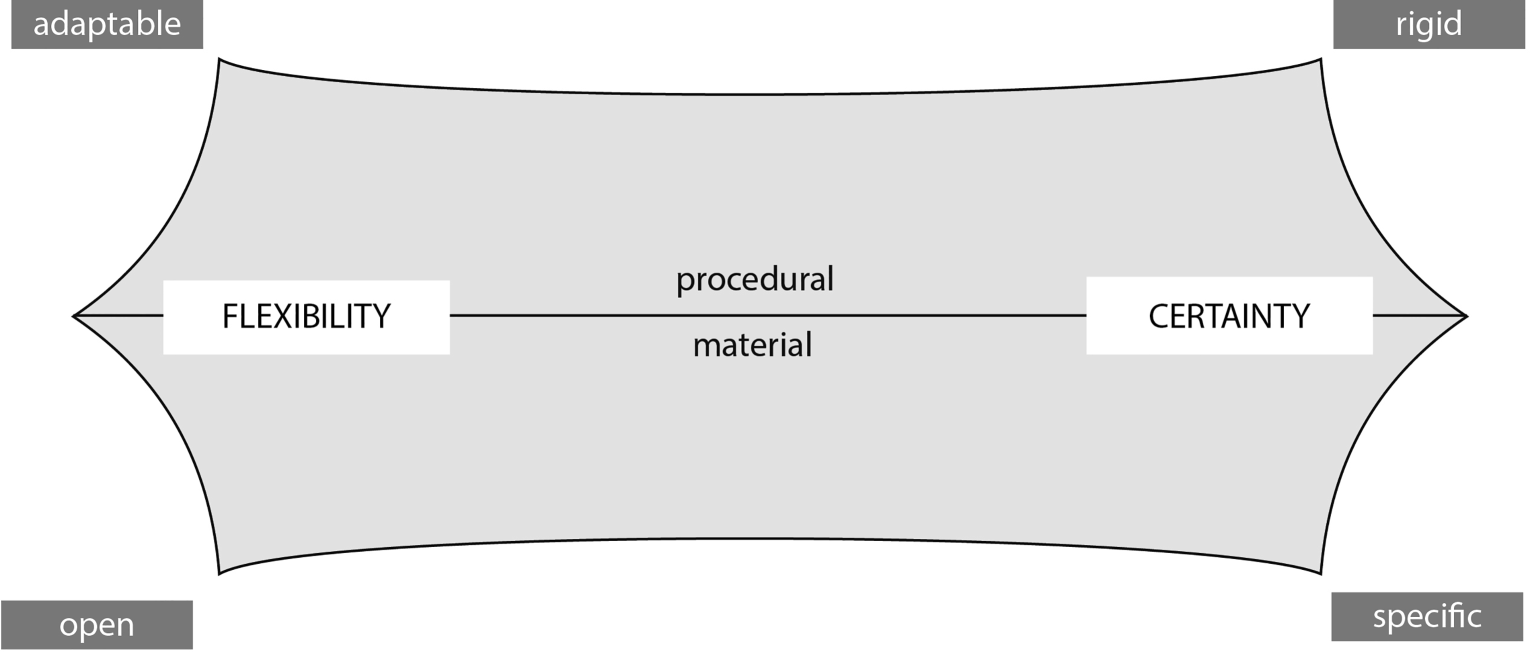
For the procedural dimension in particular, it is important to distinguish between the distinct stages at which flexibility and certainty operate. In plan preparation, flexibility means that a plan can be set up easily with few formal requirements, whereas certainty entails a highly regulated procedure with clearly specified steps. In plan implementation, flexibility means that deviations from the plan can be easily achieved. Certainty, conversely, makes such deviations more difficult.
Discussions about flexibility and certainty have focused on various planning systems and regions. The tension between the two has been examined from multiple perspectives, yielding diverse insights. In their analysis of flexibility and certainty in the Dutch planning system, van den Hoek, Spit and Hartmann (2020) emphasise that the relationship is more nuanced than a simple dichotomy, because the material and procedural dimensions must also be considered. They argue that “the belief that a demise of the one leads to the increase of the other does not take the full complexity of the balance between flexibility and legal certainty into consideration” (van den Hoek/Spit/Hartmann 2020: 7).
Steele and Ruming (2012) argue that debates in Australia over flexibility versus certainty merely distract from other, more pressing issues. Rather than discussing how to balance certainty with flexibility from a procedural perspective, they suggest that the focus should be on more substantive and holistic questions of how planning can promote sustainable development (Steele/Ruming 2012: 173).
Flexibility is often associated with discretionary planning systems (in which land-use plans are indicative rather than binding, such as in England), whereas certainty is linked to regulatory planning systems (in which land-use plans are binding, such as in Germany, France and the Netherlands) (Booth 1996: 5, 6). However, Dembski and O’Brien (2023) argue that this distinction can be overly simplistic and does not capture the full reality of practice. Although developers in discretionary systems face uncertainty about whether a specific application will be permitted, developers in plan-led systems may face uncertainty during plan preparation – whether a plan will be adopted and with what specifications (Dembski/O’Brien 2023: 583, 588). Additionally, they describe how developers in England have called for greater certainty in the planning system. This is contrary to general notions in Germany, where often developers demand more flexibility from the planning regime (e.g., ZIA 2024).
Although the debate has taken place mainly in the international planning literature, there has also been discourse concerning the tension in German jurisprudence. In a 1989 ruling on § 31 (2) BauGB (the provision on exemptions), the Federal Administrative Court stated: “According to the ideas of the legislator, the realisation of justice in individual cases and the desired urban planning flexibility intended in § 31 (2) BauGB are to be harmonised with the requirement of reliability in a differentiated manner”.8 A legal commentary on the same provision explains how exemptions introduce necessary flexibility, as development plans cannot define the legal situation down to the last detail; without exemptions development plans would be under constant pressure to change. They also serve to ensure fairness in individual cases (Battis/Krautzberger/Löhr et al. 2022, § 31 Rn 1). However, this flexibility and fairness in individual cases must be reconciled with the rule of law and legal certainty: “Consistency and flexibility of the law are therefore in tension with each other” (Battis/Krautzberger/Löhr et al. 2022, § 31 Rn 2, authors’ translation).
The methodology employed in this study consisted of two main components: a literature review and document analysis, complemented by semi-structured interviews with planning officials.
A document analysis was conducted to determine the legal and institutional framework and to gain an understanding of the overall development of planning law, as well as current political initiatives and debates. The consulted documents included policy documents such as official guidelines for the application of laws (e.g., Senatsverwaltung für Stadtentwicklung, Bauen und Wohnen Berlin 2025) and governmental communication about ongoing legislative changes.9 The judicial documents consulted included the statutory texts themselves, as well as court rulings10 and legal commentaries (Battis/Krautzberger/Löhr et al. 2022; Spannowsky/Uechtritz/Birk et al. 2022; Ernst/Zinkahn/Bielenberg et al. 2023).
Empirical data was collected through semi-structured interviews with planning officials. The interviewees were based in German municipalities that met three criteria: 1) a population exceeding 250,000 to ensure specialised administrative experience and a sufficient caseload; 2) a location in Western Germany, where development plans tend to be older and more diverse than in Eastern Germany; and 3) a formal classification as a “constrained housing market”, indicating high housing demand that fosters the application of regulatory instruments. In total, ten interviews were conducted online and in person across nine Western German cities in May and June 2024.
Eight interviewees worked in urban planning departments (Stadtplanungsamt), two were employed by a building regulatory agency (Bauordnungsamt). Although responsibilities vary from city to city, the urban planning department is often responsible for drafting development plans and for reviewing the admissibility of a construction project under planning law. The building regulatory agency processes building applications and issues final building permits.
The interview guide addressed participants’ assessments of older development plans, recurring challenges in handling non-conforming building applications and legal hurdles to inner-urban development. Questions were asked about the typical procedures for granting exemptions, including the actors involved, procedural limits and practical challenges. Participants were asked to describe common situations in which exemptions are requested, to discuss which provisions of development plans are most frequently affected and to explain the limits of such exemptions. Where interviewees were unable to identify recurring scenarios, the questions were instead discussed at a more general or abstract level. Further topics included temporal changes, legal certainty, court proceedings, links to other provisions of the Building Code (BauGB) and urban planning instruments.
Eight of the ten interviews were recorded and transcribed. For two interviews, notes were taken instead, in accordance with the interviewees’ request. The material was analysed using a coding approach with deductive-inductive category formation. Deductive codes were derived from the theoretical framework and the interview guide. During the coding process, additional inductive codes were developed to capture emerging themes and topics that appeared relevant but had not been anticipated. The analysis focused on identifying key statements, recurring patterns and lines of argumentation, while also taking into account differences, distinctions and divergent assessments across the interviews. The interview statements are aggregated and presented in a summarised form.
As discussed in Section 1, urban planning is increasingly focusing on the development of existing urban structures. When reviewing planning applications, municipalities often have to assess them against older plans, sometimes dating back several decades. It is important to note that – from a legal perspective – German development plans remain valid indefinitely until changed through a formal procedure.11Regarding the content, however, a plan may become outdated in the sense that its implementation is no longer desirable and its stipulations contradict current ideas of desired qualities in the urban environment. In this paper, the term “old development plans” refers to plans that are no longer desirable in content but remain legally valid.
Development plans are intended to provide a binding framework for urban development. They are created under specific conditions and aim to address those conditions. If the conditions change, the development plan can no longer fulfil its intended function, and municipalities may be confronted with a building proposal that fails to fit the existing plan.
As noted above, flexibility and the capacity to adapt depend on both the material and procedural dimensions. In Germany, material flexibility is linked to the content and level of detail of each individual plan. Even though the Federal Land Utilisation Ordinance (Baunutzungsverordnung)12 provides a German-wide standard for the elaboration of development plans, the specific details of each plan – including the degree of regulation and level of detail – are the responsibility of the municipality that draws up and adopts it. Building boundaries can, for example, be drawn very broadly or very narrowly. In particular, newer plans tend to have a high level of detail and greater regulatory intensity.
In contrast to material flexibility, which varies across individual plans, procedural flexibility in Germany is inherent to the system and depends less on the plan itself. This is because the rules for adapting a plan (i.e., amending it, repealing it or granting an exemption) are largely determined by the Federal Building Code.
If the proposed project does not comply with the plan, municipalities may amend the plan or create a new one. The interviews showed that because of the complexity of plan preparation procedures and the resources they require, municipalities carefully consider whether a project is worth the effort. Therefore, new development plan procedures are usually initiated only for projects sufficiently large to justify the expense. In other cases, exemptions become relevant. This procedural aspect is examined in detail in the following segment.
When faced with a building proposal that is not in keeping with the existing plan, municipalities can examine whether the deviation can be justified under an exemption. Exemptions are thus an important tool for handling old plans. Section 2 has outlined the legal requirements for exemptions; this section explains how municipalities use this instrument in practice, based on interviews with relevant planning officials. The sample included a limited number of large, growing municipalities in Western Germany where building permits are issued by the local authority itself rather than – as in small towns – by the district authority. The results are therefore limited to this context.
The importance of exemptions is reflected in the fact that several respondents stated that they are more the rule than the exception, as they are requested in most building applications. At the same time, it was reported that, generally, exemptions provide little flexibility to deviate from an existing plan. Although most respondents reported an increase in applications for exemptions in recent years, they emphasised that the handling and assessment of cases have remained the same, meaning that the procedure is unchanged and the same criteria are applied. In assessing the urban planning considerations of whether an exemption can be granted, one respondent noted that climate adaptation considerations have become more important, for example in decisions on whether to permit additional surface sealing. Another respondent reported that court decisions have led them to handle exemptions more strictly.13
Interviewees frequently stressed that each case of an exemption must be judged on its own merits. Accordingly, it is difficult to arrive at a uniform picture for an instrument used nationwide. Overall, however, municipalities often have little room for manoeuvre when granting exemptions and the limits of flexibility are quickly reached. In the descriptions of typical cases, it became apparent that in general, municipalities are more open to granting an exemption in areas where building structures (in terms of use and form) are already heterogeneous or where a similar exemption has been granted in the past. A widely acknowledged limit – confirmed by all interviewees – is a change in the type of use (e.g., from commercial to residential). This can be explained by the fact that case law has established that the type of use regularly affects the basic principles of the plan (Ernst/Zinkahn/Bielenberg et al. 2023: § 31 Rn 36).14 Another limit is reached if a proposal involves an extensive exceedance of permitted building mass, although municipalities differed in how they interpreted “extensive”. While not an absolute limit, the interviews revealed that the interests of neighbours are a recurring topic that receives special attention. These interests must be taken into account according to the legal basis for exemptions anyway, but the issue receives special attention, as an important consideration is whether a decision would withstand a potential legal challenge. Because neighbour complaints frequently lead to such challenges, authorities proceed more cautiously where neighbour interests are affected.
Though similarities and general trends could be identified, there were also differences in the handling of exemptions between the municipalities. This relates, on the one hand, to the scope of exemptions regarding building mass and, on the other, to the application of the newly created third paragraph of § 31 BauGB. At the time of data collection, this paragraph was still very new and the municipalities lacked experience in handling it. In particular, the requirement of “the individual case” (§ 31 (3) BauGB of 2021) was interpreted differently by respondents (a requirement that has since been abolished). Whereas some said that this requirement prevents the use of the new paragraph, others stated that they frequently use the paragraph.
It is difficult to assess or quantify the extent to which old plans pose a challenge to urban development. Interviewees offered differing views on this issue. Some argued that old plans constitute a major constraint. Common conflicts that were mentioned are proposals for housing in areas where residential use is not permitted or for building mass that exceeds permissible limits, as older plans often include lower building densities. Others stated that the municipality usually finds a solution. As one respondent put it: “For projects that are desired, planning law is usually made suitable, in one way or another”. Interestingly, some respondents even argued that older plans are less of an obstacle to development than newer plans because they tend to be less detailed and prescriptive. Such lower regulatory intensity offers more material flexibility then many newer plans. Another respondent argued that old plans can open up scope for contemporary development because the necessity of an exemption gives the municipality opportunity for negotiation between the municipality and the developer.
A motif that emerged in not all but some interviews was that when granting exemptions, municipalities are typically not only concerned with the extent to which flexibility or certainty should be considered. Rather, they also address broader questions about how the building proposal could be harmonised with a desirable urban development. Sometimes, the existence of an old development plan and the need for an exemption can give the municipality an opportunity to enter into talks with the project developer and provide leverage in potential negotiations.
If the development plan is in line with the proposed project, the developer has the right to building permission (under the condition that he also complies with other regulations) and can develop the project without further ado. Similarly, if there is no development plan (and § 34 BauGB applies), the developer has the right to realise the project if it is in keeping with the immediate surroundings. However, the situation is different when an exemption is needed. Usually, developers are not entitled to an exemption and the municipality has discretionary power concerning whether the exemption is granted or not (Ernst/Zinkahn/Bielenberg et al. 2023, Rn 61). The need for an exemption can provide the municipality “the opportunity to enter into dialogue with the project developer”, as one interviewee made clear.
When deciding about an exemption, a municipality has to balance flexibility (in this case allowing the development) with legal certainty (the reliability of the plan and the need for a legally sound decision) for the requested exemption (e.g., adding another storey to a building). In the interviews it became evident that in some instances, the interests of the municipalities go beyond the requested exemption itself and they try to include other aspects, like greening of the roof or the appearance of the building. Municipalities do not just accept or reject an exemption, they rather try to determine appropriate conditions under which they could grant the exemption or the way in which a project should be modified.
Planning law provides the option of recording conditions for an exemption formally, either as ancillary provisions for the exemption or in a separate contract between the developer and the municipality (Baudispensvertrag), which sets out the conditions for granting the exemption (Battis/Krautzberger/Löhr et al. 2022, § 31 Rn. 48). The developer can also amend their plans independently, following initial discussions.
Limits on these negotiations derive from the legal framework, in particular the prohibition of placing extraneous requirements on the project, i.e. requirements which are not based on the general planning law statute and which therefore cannot be imposed on the building project in order to grant an exemption (Ernst/Zinkahn/Bielenberg et al. 2023, § 31 Rn. 61, 62). Another clear limitation are the previously mentioned narrow limits which constrain the granting of an exemption (in particular the basic principles of the development plan, § 31 (2) BauGB). Despite these constraints, the beforementioned possibility to “enter into dialogue” and speak with the developer is considered valuable by the municipalities.
Negotiation processes are also described in other empirical research. A survey of different local authorities’ views on amendments to planning law describes the importance of negotiations and the leverage of municipalities. The officials emphasised the importance of the negotiation position of the municipality and that municipalities try to raise their concerns in negotiations for exemptions and waivers (Steinbach/Lau/Faller et al. 2025: 9). A comparative survey showed that a range of regulatory instruments (such as exemptions, urban regeneration measures or design guidelines) can serve as leverage to influence development in a communicative and collaborative way (Krusenotto/Michalski/Strauss et al. 2026). Though not included in the research sample, the district of Berlin-Neukölln has even formalised and standardised agreements with developers through the Neukölln Model for Neighbourhood-friendly Housing Construction (Neuköllner Modell für einen kiezverträglichen Wohnungsbau). For exemptions that exceed a certain level, developers must commit to creating at least 30 % affordable housing and contribute to the financing of primary-school and day-care places if the current facilities in the area are insufficient (Stadtentwicklungsamt Neukölln 2024). The district argues that in the case of an exemption for urban development reasons (§ 31 (2) No 2 BauGB), there is sufficient discretionary scope to link the exemption to the aforementioned conditions. Elsewhere, however, no comparable model was found. The Neukölln model is distinct, related to the special nature of the Berlin Baunutzungsplan, a particular plan for Berlin from 1958/1960 that does not exist in other cities.
Dörr (2019) describes similar processes of negotiations for the application of § 34 BauGB, which was originally designed as a substitute standard for cases where no valid development plan exists. This section is intended to be applied strictly, with no room for interpretation or for implementing planning ideas. In practice, however, its application is not so straightforward due to the vague legal terminology used and differences between cases. Local authorities may be able to exercise discretion in certain circumstances and pursue their development interests in ways that were not originally intended: “As soon as there is scope for a certain range of reasonable approval decisions within the context of § 34 BauGB, informal negotiation processes between the municipality and the investor can become a decisive factor” (Dörr 2019: 224; authors’ translation).
Processes of negotiation in granting exemptions show how unilateral administrative acts can have elements of cooperation in practice. In theory, the process of granting building permission is a unilateral administrative act in which permission is awarded or not (Schmidt-Eichstaedt/Weyrauch/Zemke 2019: 12–13). However, in practice, talks between the developer and municipality take place. Nevertheless, the opportunity and scope for such negotiations are only provided by the formal necessity for building permission and in particular an exemption. This communicative element, with cooperation between public and private stakeholders, is well established for new development plans, which are often set up in close cooperation with developers and in larger municipalities often involve formalised requirements, so-called Baulandmodelle (Pätzold/Frölich von Bodelschwingh/Bunzel 2023). A cooperative form of development plans is also codified as project-based development plans (vorhabenbezogener Bebauungsplan, § 12 BauGB). These types of plans combine regulatory and cooperative elements. Clearly, as this research shows, elements of cooperation and negotiations also take place at the stage of plan implementation for individual construction projects, in a more fragmented and differentiated form. Such approaches align with the broader trend towards more cooperative forms of urban development and away from a focus on unilateral, top-down planning; these approaches emphasise joint development processes, involving the relevant stakeholders (Fürst 2018).
The use of legal constraints for negotiations can be discussed critically. On the one hand, this may be a pragmatic solution to achieve municipal (public-welfare-orientated) goals. On the other hand, it raises questions about legal integrity. Buitelaar and Sorel (2010) describe how outdated plans are used in the Netherlands to increase a municipality’s influence. They recognise the motives and justifications behind this but also raise critical points. This practice reduces legal certainty and creates (material) uncertainty, in particular for developers. They also see potential impairments of the rule of law, including arbitrariness and inconsistent policies. Dörr (2019) raises questions in connection with the pragmatic application of § 34 BauGB and the pursuit of municipal planning interests. He includes questions of democratic legitimacy (including the weighing up of various interests, Abwägung) and procedures under the rule of law (Dörr 2019: 274–276).
Urban development brings together a number of stakeholders with different interests. At the implementation of plans, as discussed in this paper, stakeholders regularly include three parties: the developer, the municipality and the neighbours. Their perspectives on flexibility and certainty diverge according to their interests. The interviews revealed how developers, either institutional developers or private persons, often express a wish for more flexibility to be able to realise their projects as they desire, e.g., by increasing building mass. In practice, the desire for flexibility is often manifested in the fact that developers wish to carry out the building project under an exemption so that they do not have to go through a development plan process. Conversely, neighbours often insist on certainty and compliance with the applicable planning law, aiming to protect their property (rights) and minimise negative influences from other properties. While these descriptions might be a little simplistic, they are likely to be accurate more often than not (see for example BFW 2025 for the perspective of developers; McClymont/Hickman/Dembski 2025: 48 for perspective of neighbours). As shown in the research, the preferences of planning institutions can change. They may have an interest in the flexible handling of plans, if this furthers their goals (e.g., construction of new housing). If an old plan indicates less density and the municipality’s interest is to minimise soil sealing, they may have an interest in more certainty. And, as shown, sometimes municipalities use exemptions to enter into dialogue with developers. At all times, they have to make a legally sound decision, which is a driver for legal certainty.
Flexibility is sometimes associated with a negative impact on municipalities’ planning agency, as it gives them less opportunities to influence development. In discussion around the introduction of the § 246e BauGB (Bauturbo) for example, German municipalities expressed their concerns about dwindling development control (Steinbach/Lau/Faller et al. 2025). This study has shown that over the course of time, high certainty, especially in the procedural dimension, may be contrary to municipalities’ interests as well: old plans might no longer reflect municipalities’ planning ideas and intentions, but cannot be easily changed (a similar idea is raised by Neuner 2025: 153). Muñoz Gielen and Tasan-Kok (2010) describe how more certainty before the development of a project might result in less opportunities for capturing public value: when development opportunities are determined early in the plan-making process, municipalities could lose a valuable negotiation tool.
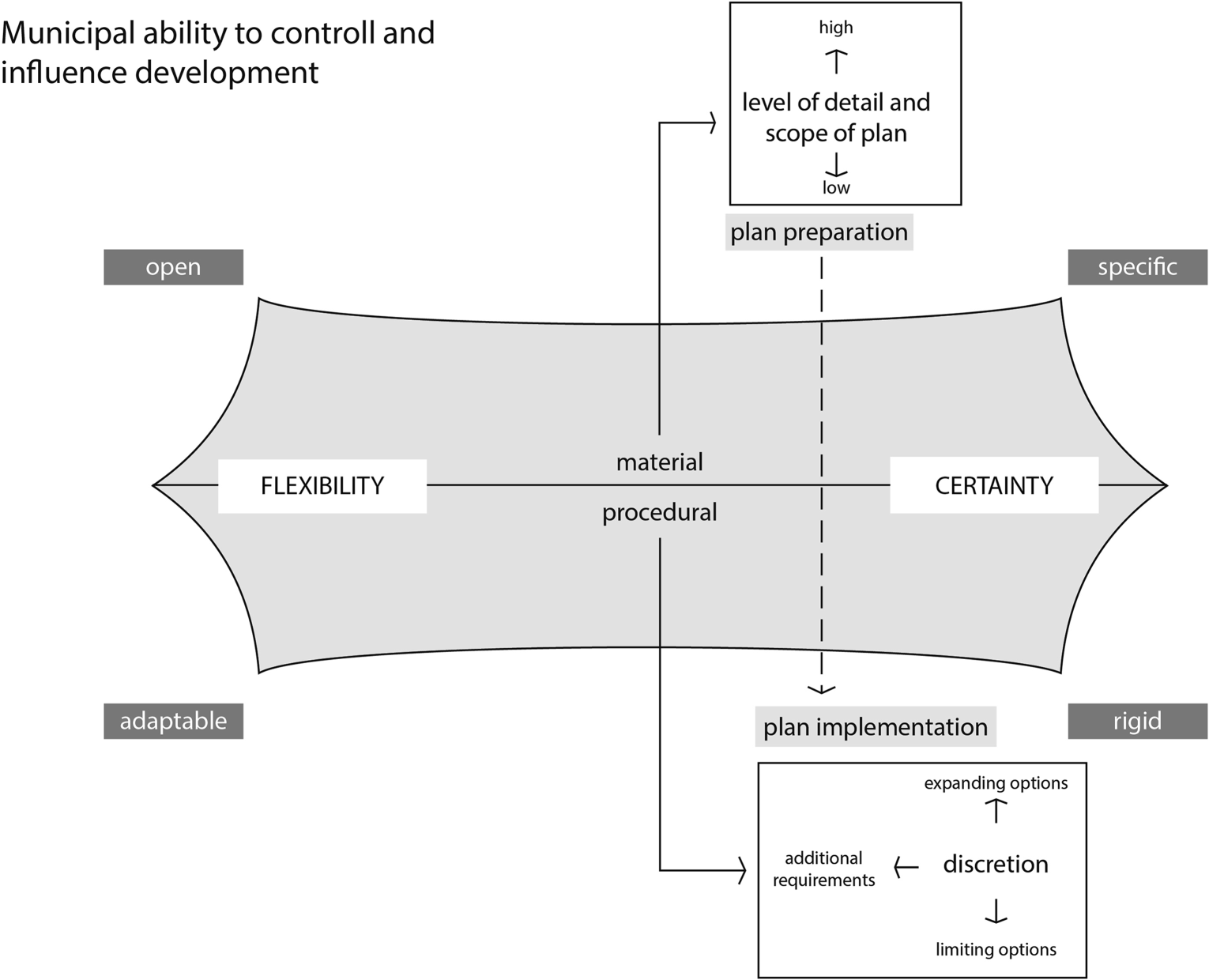
At the time of plan preparation, in the material dimension the scope and detail of a plan influence the way in which municipalities can exert planning influence. For example, a plan may have a very low level of detail and only include provisions which forbid gambling establishments, activities associated with red-light districts and similar. This provides high material flexibility and also makes compliance with the plan and therefore legal certainty easier, as the probability that a project conflicts with the plan is lower (this refers only to legal certainty in a narrow sense, not certainty about urban development – while compliance with the plan is simple, the predictability of development in general is lower). But the opportunities for the municipality to influence the development of the built environment are rather limited. Only the aforementioned activities can be rejected, no further specifications can be made. At the time of plan implementation, in the procedural dimension planning influence is manifested in the discretion a municipality has to deviate from a plan. Flexibility is often associated with an expansion of the building options available to developers. This is also the case in the German planning system, where opportunities for flexibility most often increase the options available to developers rather than restricting them (Neuner 2025: 22). But theoretically, flexibility could also include deviations from a plan that restrict construction options further. The discretion available to the planning authority to deviate from a plan in either way – that is restricting or expanding building opportunities or posing completely new requirements – determines (among other things) the planning influence that an authority can exercise.
The introduction of §246e BauGB in October 2025 (Bauturbo, see Section 2) opened up opportunities for far-reaching flexibility, as it is now possible to deviate from any regulations in a plan. At the same time, local authorities have considerable discretion, as municipalities must approve any deviations and it is assumed that they have considerable leeway in their decision-making (Senatsverwaltung für Stadtentwicklung, Bauen und Wohnen Berlin 2025: 31). This provides opportunities for both greater flexibility and greater planning influence, as municipalities have the option but not the obligation to allow far more activities than before. It comes at the expense of certainty: plans become less reliable and the processes offer little procedural certainty. At the time of writing, experiences with the new paragraph were limited and it remains to be seen how the changes will play out in reality.
This research provides an initial exploratory study with a limited number of interviews. Therefore, an important limitation lies in the selection of the municipalities. As described in Section 4, we focused on larger cities in which the building permit authority is also the planning authority. Examining smaller municipalities could yield interesting results, since building permit approval is often carried out at district level in these cases and therefore in a different entity than where the plan has been drawn up. A deeper examination of one case, e.g., by interviewing different persons and authorities within the municipality, could yield insights into the specific dynamics and interests. While the interviews provided valuable insights, a social desirability bias is unavoidable in all qualitative interviews. In particular, participants may be reluctant to reveal all of their motives if these deviate from the legal context. The limited number of interviews raises questions about the extent to which the results can be generalised. The use of planning instruments is always context-dependent and cannot be fully captured in a general interview.
Within debates about instruments for inner-urban development, we have examined two important dimensions that are of great significance in democratic systems: certainty and flexibility. To this end, we investigated how German municipalities deal with existing development plans when a construction project does not comply with the plan’s specifications. Despite the challenges involved in obtaining a comprehensive overview, the difficulties of dealing with old development plans became apparent, as development plans cannot be changed without considerable effort and exemptions, despite being widespread, usually offer only limited deviations from a plan. Furthermore, we have outlined how local authorities sometimes try to bring their own interests into play through negotiation when granting exemptions. When discussing flexibility and certainty, an important aspect to consider is the extent to which the municipality can influence development. At the time of plan preparation, this depends on the scope and level of detail of the plan. At the time of plan implementation, it depends on the discretion available to municipalities.
We understand planning as a day-to-day practice within the administration and as part of everyday processes of formal and informal practices. The cultures of these practices develop over time within organisations and institutions through the ways in which knowledge is reproduced, the traditions and norms that prevail and the routines that develop (Othengrafen/Reimer 2018). It is in these day-to-day activities that the two dimensions of flexibility and certainty must prove their worth. Neither of these two dimensions is per se good or bad, preferable or unfavourable. What is needed is an assessment of the needs and desires behind preservation and change, as well as of which interests are over- or under-represented. The legal framework and decision-making processes are important factors but at the same time, they form the foundation for cooperation and communication.
The capacity to develop and adapt existing built structures will become increasingly important (Förster/Karow-Kluge/Weber 2025). The (legal) management and development control is an important aspect of this complex task. Recent changes in planning law, including much greater possibilities for exemptions – when the local authority gives consent (see Section 2) – seem likely to have a considerable impact here. For the purposes of housing, old plans might no longer pose a challenge and the recent amendments might help to facilitate small-scale, incremental developments. But the shift from an administrative to a political decision has the potential to change the dynamics fundamentally. Negotiation processes, which we have observed on a small scale, might become more prominent. Considerations, which before would have formed part of a formal planning procedure, will be dealt with during the implementation phase. It remains to be seen how this will impact legal certainty: the reliability of plans and procedures.
It is still unclear how certainty and flexibility will be negotiated under the new conditions. Regardless of what the regulation will look like in the long term, the recent changes, including the temporary Bauturbo, as well as the permanently extended possibilities for exemptions, have already created new circumstances. Flexibility and certainty are not only legal dimensions, but also guiding principles for action, which must be reliable while also allowing scope for vital adaptations of the existing built environment. A further concern is also how conflicts and incompatible demands − which are often inherent in inner-urban development processes − are managed and how the interests of third parties, such as neighbours, are taken into account.
References
| Adrian, L.; Bock, S.; Bunzel, A.; Preuß, T.; Rakel, M. (2018): Instrumente zur Reduzierung der Flächeninanspruchnahme. Aktionsplan Flächensparen. Dessau-Roßlau. = UBA-Texte 38/2018. |
| Battis, U.; Krautzberger, M.; Löhr, R.-P.; Mitschang, S.; Reidt, O. (2022): Baugesetzbuch: Kommentar. München. |
| BFW – Bundesverband Freier Immobilien- und Wohnungsunternehmen (2025): Stellungnahme zum Entwurf eines Gesetzes zur Beschleunigung des Wohnungsbaus und zur Wohnraumsicherung. Berlin. |
| Blum, A.; Atci, M.M.; Roscher, J.; Henger, R.; Schuster, F. (2022): Bauland- und Innenentwicklungspotenziale in deutschen Städten und Gemeinden. Bonn. = BBSR-Online-Publikation 11/2022. |
| Booth, P. (1996): Controlling Development. Certainty and discretion in Europe, the USA and Hong Kong. London. |
| Buitelaar, E.; Sorel, N. (2010): Between the rule of law and the quest for control: Legal certainty in the Dutch planning system. In: Land Use Policy 27, 3, 983–989. https://doi.org/10.1016/j.landusepol.2010.01.002 |
| Bunzel, A.; Coulmas, D.; Frölich von Bodelschwingh, F.; Krusenotto, M.; Lau, P.; Strauss, W.-C. (2023): Neue Instrumente der Baulandmobilisierung: Handreichung. Berlin. = Difu-Impulse 2/2023. |
| Dembski, S.; O’Brien, P. (2023): The quest for certainty: Introducing zoning into a discretionary system in England and the European experience. In: Raumforschung und Raumordnung | Spatial Research and Planning 81, 6, 579–590. https://doi.org/10.14512/rur.1695 |
| Dörr, S. (2019): Pragmatische Stadtentwicklung nach § 34 Baugesetzbuch? Die Realisierung von kommunalen Steuerungsinteressen und Bürgerbeteiligung im unbeplanten Innenbereich. Baden-Baden. = Berliner Schriften zur Stadt- und Regionalplanung 38. https://doi.org/10.5771/9783748905004 |
| Ernst Basler + Partner AG (2013): Langfristige Siedlungsentwicklung. Konzeptgutachten. Zürich. |
| Ernst, W.; Zinkahn, W.; Bielenberg, W.; Krautzberger, M. (2023): Baugesetzbuch. Kommentar. München. |
| European Commision (2021): EU Soil Strategy for 2030. Reaping the benefits of healthy soils for people, food, nature and climate. Brussels. COM(2021) 699 final. |
| Faller, B.; Steinbach, F. (2024): Zu Recht in der Kritik und doch eine Chance? Was man aus dem Bauturbo und dem § 246e BauGB noch machen könnte! Berlin. = vhw-Debatte 04/2024. |
| Fawaz, M. (2017): Exceptions and the actually existing practice of planning: Beirut (Lebanon) as case study. In: Urban Studies 54, 8, 1938–1955. https://doi.org/10.1177/0042098016640453 |
| Feiertag, P.; Schoppengerd, J. (2023): Flexibility in planning through frequent amendments. The practice of land use planning in Germany. In: Planning Practice and Research 38, 1, 105–122. https://doi.org/10.1080/02697459.2022.2133459 |
| Fingland, D. (2011). Better to be roughly right rather than exactly wrong: the concept of certainty in land use planning. Conference Paper. 5th State of Australian Cities National Conference, 29 November‑2 December 2011. |
| Förster, A.; Karow-Kluge, D.A.; Weber, A.M. (2025): Prozesse und Praktiken des Umbauens: Skizze einer Landkarte für Forschung und Praxis. In: pnd – rethinking planning 2, 187–207. https://doi.org/10.18154/RWTH-2025-05387 |
| Förster, A.; Karow-Kluge, D.A.; Weber, A.M.; Jimenez Mattsson, C. (2025): Editorial. In: pnd – rethinking planning 1, 5–9. https://doi.org/10.18154/RWTH-2025-03380 |
| Fürst, D. (2018): Planung. In: ARL – Akademie für Raumforschung und Landesplanung (Hrsg.): Handwörterbuch der Stadt- und Raumentwicklung. Hannover, 1711–1719. |
| Grotefels, S.; Schoen, H. (2020): Das Baugesetzbuch – Eine aktuelle Einschätzung. In: Wüstenrot-Stiftung (Hrsg.): Bedingt planbar: Städtebau und Stadtentwicklung in Deutschland und Europa. Ludwigsburg, 180–187. |
| Hartmann, T. (2026): Damit der Bauturbo nicht zum Korruptionsturbo wird – Wieso es jetzt mehr Transparenz zum Eigentum braucht. In: Raumforschung und Raumordnung | Spatial Research and Planning 84, 2, 79–83. https://doi.org/10.14512/rur.3577 |
| Hickman, H.; Dembski, S.; McClymont, K.; Leshinsky, R. (2026): Guest Editorial. Unmaking plans: enforcement, modification and the erosion of consent. In: disP – The Planning Review 61, 4, 4–9. https://doi.org/10.1080/02513625.2025.2632526 |
| Klemme, M.; Maikämper, M.; Stockdreher, B.; Willinger, S. (2026). Kommunalbefragung Bau-Turbo. Auswertung von Fragen zur BauGB-Novelle und zur kommunalen Planungspraxis. Bonn. = BBSR-Analysen Kompakt 01/2026. |
| Krautzberger, M. (2020): Städtebaurecht. In: Beckmann, K.J. (Hrsg.): Raumplanung, Stadtentwicklung und Öffentliches Recht. Wiesbaden, 43–50. https://doi.org/10.1007/978-3-658-27918-9_43 |
| Krusenotto, M.; Michalski, D.; Strauss, W.-C.; Tomerius, S. (2026): Regulative Baukultur. Potenziale des Bau- und Vergaberechts für die Qualität des gestalteten Raums. Bonn. https://doi.org/10.58007/b1e3-p826 |
| Lütke Daldrup, E.; Zlonicky, P. (Hrsg.) (2009): Große Projekte in deutschen Städten. Stadtentwicklung 1990-2010. Berlin. |
| McClymont, K.; Hickman, H.; Dembski, S. (2025): Negotiated, approved … ignored? Regulating development after approval in England and Germany. In: disP – The Planning Review 61, 4, 40–54. https://doi.org/10.1080/02513625.2025.2632543 |
| Moroni, S. (2015): Complexity and the inherent limits of explanation and prediction: Urban codes for self-organising cities. In: Planning Theory 14, 3, 248–267. https://doi.org/10.1177/1473095214521104 |
| Muñoz Gielen, D.; Tasan-Kok, T. (2010): Flexibility in Planning and the Consequences for Public-value Capturing in UK, Spain and the Netherlands. In: European Planning Studies 18, 7, 1097–1131. https://doi.org/10.1080/09654311003744191 |
| Munzinger, T.; Niemeyer, E.M. (2022): Baugesetzbuch für Planer im Bild: praxisgerecht kommentiert und grafisch umgesetzt. Köln. |
| Needham, B.; Buitelaar, E.; Hartmann, T. (2019): Planning law and economics: the rules we make for using land. New York. |
| Neuner, O. (2025): Flexibilisierung des Planrechts: Verfassungs- und unionsrechtliche Spielräume für die Schaffung bauplanungsrechtlicher Befreiungstatbestände. Berlin. = Schriften zum Öffentlichen Recht 1571. https://doi.org/10.3790/978-3-428-59396-5 |
| Othengrafen, F.; Reimer, M. (2018): Planungskultur. In: ARL – Akademie für Raumforschung und Landesplanung (Hrsg.): Handwörterbuch der Stadt- und Raumentwicklung. Hannover, 1733–1739. |
| Partanen, J. (2020): Guiding urban self-organization: Combining rule-based and case-based planning. In: Environment and Planning B: Urban Analytics and City Science 47, 2, 304–320. https://doi.org/10.1177/2399808319893687 |
| Pätzold, R.; Frölich von Bodelschwingh, F.; Bunzel, A. (2023): Praxis der kommunalen Baulandmobilisierung und Bodenpolitik. Ergebnisse einer Kommunalumfrage (2020) und von Untersuchungen in 16 Fallstudienstädten (2021). Berlin. = Difu-Impulse 3/2023. |
| Petersen, M.; Yurdakul, D.G. (2023): Beschleunigung der Planverfahren nach dem Baugesetzbuch. Vorschläge der Vereinigung für Stadt‑, Regional- und Landesplanung. Berlin. |
| Savini, F.; Majoor, S.; Salet, W. (2015): Dilemmas of planning: Intervention, regulation, and investment. In: Planning Theory 14, 3, 296–315. https://doi.org/10.1177/1473095214531430 |
| Schmidt-Eichstaedt, G. (2018): Bauleitplanung. In: ARL – Akademie für Raumforschung und Landesplanung (Hrsg.): Handwörterbuch der Stadt- und Raumentwicklung. Hannover, 139–160. |
| Schmidt-Eichstaedt, G.; Weyrauch, B.; Zemke, R. (2019): Städtebaurecht. Einführung und Handbuch. Stuttgart. |
| Schramm, S.; Bize, A. (2023): Planning by Exception: The Regulation of Nairobi’s Margins. In: Planning Theory 22, 3, 316–337. https://doi.org/10.1177/14730952221137706 |
| Senatsverwaltung für Stadtentwicklung, Bauen und Wohnen Berlin (2025): Berliner Leitfaden Wohnungsbau-Turbo. Berlin. |
| Skog, K.L.; Hengstermann, A. (2025): When the exception becomes the rule … Analysing dispensations in the Norwegian planning system. In: disP – The Planning Review 61, 4, 10–24. https://doi.org/10.1080/02513625.2025.2632530 |
| Spannowsky, W. (2018): Planungsrecht. In: ARL – Akademie für Raumforschung und Landesplanung (Hrsg.): Handwörterbuch der Stadt- und Raumentwicklung. Hannover, 1749–1759. |
| Spannowsky, W.; Uechtritz, M.; Birk, H.-J.; Busse, J.; Couzinet, D.; Dirnberger, F.; Kraft, I.; Petz, H. (2022): Baugesetzbuch. Kommentar. München. |
| Stadtentwicklungsamt Neukölln (2024). Merkblatt Neuköllner Modell für kiezverträglichen Wohnungsbau. Berlin. |
| Steele, W.; Ruming, K.J. (2012): Flexibility versus Certainty: Unsettling the Land-use Planning Shibboleth in Australia. In: Planning Practice and Research 27, 2, 155–176. https://doi.org/10.1080/02697459.2012.662670 |
| Steinbach, F.; Lau, P.; Faller, B.; Coulmas, D. (2025): Praxistest „Bauturbo“ § 246e BauGB. Einschätzungen aus kommunaler Perspektive. Berlin. = vhw-Debatte 06/2025. |
| van Buuren, A.; Driessen, P.P.J.; van Rijswick, M.; Rietveld, P.; Salet, W.; Spit, T.; Teisman, G. (2013): Towards Adaptive Spatial Planning for Climate Change. Balancing Between Robustness and Flexibility. In: Journal for European Environmental and Planning Law 10, 1, 29–53. https://doi.org/10.1163/18760104-01001003 |
| van Damme, L.; Galle, M.; Pen-Soetermeer, M.; Verdaas, K. (1997): Improving the performance of local land-use plans. In: Environment and Planning B: Urban Analytics and City Science 24, 6, 833–844. https://doi.org/10.1068/b240833 |
| van den Hoek, D.; Spit, T.; Hartmann, T. (2020): Certain flexibilities in land-use plans towards a method for assessing flexibility. In: Land Use Policy 94, 104497. https://doi.org/10.1016/j.landusepol.2020.104497 |
| Wissenschaftliche Dienste des Deutschen Bundestags (2019). Rechtslage zu funktionslos gewordenen Bebauungsplänen. Berlin. |
| ZIA – Zentraler Immobilien-Ausschuss e.V. (2024): ZIA-Stellungnahme: Entwurf eines Gesetzes zur Stärkung der integrierten Stadtentwicklung. Berlin. |
Footnotes
| 1 | The term Bebauungsplan has various translations, such as “binding land-use plan” or “zoning plan”. This paper uses the term “development plan”. |
| 2 | Baugesetzbuch (BauGB) as published on 3 November 2017 (BGBl. I p. 3634), as last amended by Article 8(2) of the Act of 23 July 2026 (BGBl. 2026 I No. 226). |
| 3 | Gesetz zur Beschleunigung des Wohnungsbaus und zur Wohnraumsicherung of 27 October 2025 (BGBl. 2025 I No. 257). |
| 4 | Grundgesetz für die Bundesrepublik Deutschland in the consolidated version published in the Federal Law Gazette, Part III, Section 100‑1, as last amended by Article 1 of the Act of 22 March 2025 (BGBl. 2025 I No. 94). |
| 5 | In contrast, § 30 (1) BauGB allows only exceptions that are specifically provided for in the development plan. |
| 6 | Gesetz zur Mobilisierung von Bauland (Baulandmobilisierungsgesetz) of 14 June 2021. |
| 7 | Gesetz zur Beschleunigung des Wohnungsbaus und zur Wohnraumsicherung of 27 October 2025 (BGBl. 2025 I No. 257). |
| 8 | BVerwG, 20.11.1989 – 4 B 163/89 – Voraussetzungen für eine bauamtliche Befreiung (1989); authors’ translation. |
| 9 | e.g., https://www.bmwsb.bund.de/SharedDocs/kurzmeldungen/DE/2024/09/baugb-novelle.html (27.08.2026). |
| 10 | e.g., BVerwG, 20.11.1989 – 4 B 163/89 – Voraussetzungen für eine bauamtliche Befreiung (1989); BVerwG, 09.08.2018 – 4 C 7/17 – Nachbarschützende Wirkung von Festsetzungen über das Maß der baulichen Nutzung am Großen Wannsee (2018); BVerwG, 24.04.2024 – 4 C 2.23 – Funktionslosigkeit einer Festsetzung zur Geschossflächenzahl (2024). |
| 11 | Development plans may become ineffective if the area’s development to date fundamentally contradicts their objectives. However, case law has established strict requirements in this regard, so this rarely happens (Wissenschaftliche Dienste des Deutschen Bundestages 2019: 6; BVerwG, 24.04.2024 – 4 C 2.23 – Funktionslosigkeit einer Festsetzung zur Geschossflächenzahl (2024)) |
| 12 | Baunutzungsverordnung (BauNVO) as published on 21 November 2017 (BGBl. I p. 3786), as last amended by Article 2 of the Act of 3 July 2023 (BGBl. 2023 I No. 176). |
| 13 | e.g., BVerwG, 09.08.2018 – 4 C 7/17 – Nachbarschützende Wirkung von Festsetzungen über das Maß der baulichen Nutzung am Großen Wannsee (2018). |
| 14 | BVerwG, 15.03.2000 – 4 B 18/00 – Berühren der Grundzüge der Planung (2000). |