
Resilience has become a prominent concept in debates on spatial development, urban policy and regional planning (Jakubowski 2013; Kuhlicke 2018; Troeger-Weiß 2018; Troeger-Weiß 2022; Rink/Gebauer/Haase et al. 2024). Initially associated with risk prevention, climate adaptation and critical infrastructures, it is now also used to assess regional development pathways, municipal strategies and, more generally, planning under conditions of uncertainty (BMI 2021; BBSR 2024). This widening of the debate reflects a recognition that disruptive events cannot be separated from the longer-term processes through which their effects are produced. Economic crises, pandemics and extreme weather events may occur suddenly, but their regional consequences depend on demographic change, infrastructure provision, economic restructuring, ecological pressures and institutional capacity.
This perspective is particularly relevant for rural areas. Rural regions are shaped by intersecting processes of demographic ageing, economic restructuring, digitalisation, climate change, energy transition and changing demands on public services. At the same time, they cannot be reduced to a common trajectory of decline or peripheralisation. In Baden-Württemberg, rural areas differ considerably in their accessibility, settlement structure, demographic development, economic specialisation and exposure to environmental change (IREUS/ILS 2020; Janoschka/Hitzeroth/Ross 2024). Many combine globally connected manufacturing firms with locally embedded skills, civic institutions and strong attachments to place. Others face limited administrative capacity, infrastructure deficits and demographic pressure. Rural resilience therefore concerns heterogeneous constellations of resources and vulnerabilities rather than a uniform set of rural characteristics.
This heterogeneity also complicates the temporal vocabulary of resilience. In many rural areas, change is not experienced as a sequence of clearly bounded shocks followed by recovery. The closure or expansion of a major employer, the erosion of services, altered mobility patterns, housing pressure, climate impacts and new land-use demands may unfold at different speeds and reinforce one another. The notion of permanent change used in this paper therefore refers to the coexistence of gradual pressures, recurrent disruptions and uncertain turning points that require actors to interpret whether existing development paths can still be sustained.
Research has identified numerous factors that may contribute to rural resilience, including economic diversification, social capital, organisational networks, learning and collective action (Specht/Wenz/Weber et al. 2013; Adam Hernández 2021; McAreavey 2022; Li 2023). Less attention has been paid to how these factors are interpreted and connected at the intermediate level of spatial planning. This level is important because regional planning and administrative bodies operate between municipalities, sectoral administrations and state policy. They translate long-term objectives into regional agendas, mediate between competing spatial claims and connect local knowledge to wider regulatory frameworks. While their accounts do not provide a direct measure of regional resilience, they reveal how adaptive capacities and vulnerabilities are made legible within planning practice, which problems are prioritised and where room for manoeuvre is perceived.
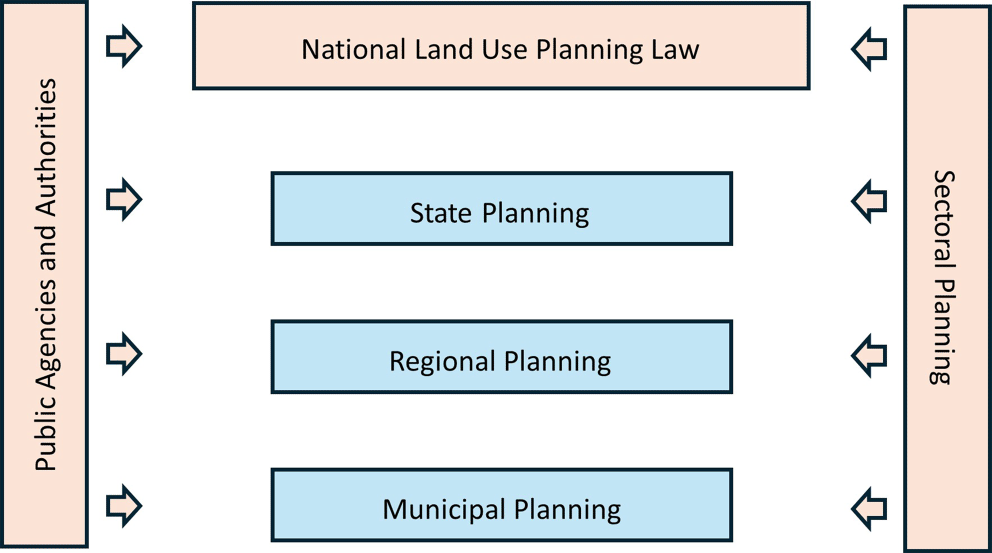
Against this background, this paper asks two questions. First, how do regional planning and administrative actors understand rural resilience and permanent change, and how do these understandings relate to adaptive-capacity thinking? Second, how do these actors frame the resources, institutional conditions and constraints associated with rural adaptation at the intermediate planning level?
The paper uses adaptive capacity as a literature-derived heuristic rather than treating it as an empirically observed outcome. Its contribution lies in reconstructing four interrelated dimensions of the interview accounts. The first two are interpretative: regional actors reframe rurality through a combination of peripheral conditions and locally specific strengths, and they normalise change by placing disruptions within longer histories of adjustment. The third is relational: adaptive capacity is associated with connections between firms, labour markets, skills, civic institutions, infrastructure and social cohesion. The fourth is institutional and political: these capacities are mobilised or constrained through planning rules, administrative resources, multi-level coordination and conflicts over land use. Together, these dimensions provide an intermediate-level perspective on rural adaptive capacity as interpretative, relational and governed.
The remainder of the paper develops this argument in five sections. Section 2 positions adaptive capacity within research on rural and regional resilience and specifies the paper’s understanding of governance. Section 3 introduces the empirical case and methodology. Section 4 develops the four analytical dimensions. Section 5 discusses their conceptual implications and the limits of the study. Section 6 concludes by specifying what a resilience perspective adds to the analysis of planning under conditions of permanent change.
Resilience is commonly associated with the capacity of a system to withstand disruption and recover from shocks. In spatial and regional research, however, the concept increasingly encompasses the capacity to learn, reorganise and alter development pathways under changing conditions (Walker/Salt 2006; Fath/Dean/Katzmair 2015). This broader understanding is necessary where short-term disruption and long-term pressure are closely intertwined. A return to an earlier state may neither be possible nor desirable when the structures that previously sustained development have themselves become sources of vulnerability.
Adaptive-systems thinking offers a vocabulary for examining this problem. Adaptive capacity refers here to the ability to anticipate vulnerabilities, mobilise and recombine resources, learn from disturbances and retain the capacity for future action. The adaptive-cycle and panarchy literature draws attention to changing relations between resources, connectivity, innovation and rigidity in complex systems (Gunderson/Holling 2002; Walker/Salt 2006; Fath/Dean/Katzmair 2015). Applied to regional development, this perspective highlights a central ambivalence: structures that provide stability may also create path dependency, lock-in and reduced flexibility. Adaptive capacity consequently includes the ability to question established arrangements and reorient development paths when earlier sources of success become restrictive.
The distinction between adaptation and adaptability sharpens this point. Adaptation may stabilise an existing development path, whereas adaptability concerns the capacity to depart from a previously successful path and pursue related or alternative trajectories (Pike/Dawley/Tomaney 2010). Rural resilience cannot therefore be assessed only by asking whether a region absorbs a disruption. It also requires attention to the direction of change, the capacities retained for future action and the distribution of the consequences of change.
Such a differentiation introduces a temporal and normative question into the analysis. Measures that appear successful in the short term may reinforce dependencies that reduce future room for manoeuvre. The retention of a dominant employer, the expansion of developable land or the informal substitution of public services by voluntary work may stabilise a locality while postponing more fundamental change. Conversely, the decline of an established industry can release skills, organisational knowledge and infrastructures that support new activities. Adaptive capacity is therefore not a fixed stock of resources. It concerns the ability to recognise when continuity remains viable, when existing resources can be recombined and when earlier development logics must be questioned.
This is also the point at which resilience becomes politically contested. Critical planning scholarship has warned that resilience may naturalise existing social relations, privilege continuity over structural change and transfer responsibility to places or communities without addressing the processes that produce vulnerability (Davoudi 2012; MacKinnon/Derickson 2013). The relevant questions are therefore not only whether a place is resilient, but what is being sustained, for whom and according to whose definition. This critique is particularly important for research based on planning and administrative actors. Their accounts make some capacities and vulnerabilities visible, but they also reflect institutional mandates, professional knowledge and specific understandings of desirable regional development.
Research on rural resilience has developed across economic, social-ecological and community-oriented strands. Economic approaches emphasise diversification, innovation and the capacity to recombine regional resources (Salvia/Quaranta 2015; Salvia/Quaranta 2017; Heijman/Hagelaar/van der Heide 2019). Locally embedded firms and specialised clusters may provide employment, skills and regional confidence, but specialisation can also generate vulnerability when local economies become dependent on individual sectors, firms or resource bases. Research on regional economic resilience therefore stresses the importance of path dependence and the capacity to renew economic structures (Simmie/Martin 2010). Studies of German lignite regions illustrate how low diversity and weak innovation may restrict such renewal (Stognief/Walk/Schöttker et al. 2019), while work on community resilience shows how economic, structural and socio-psychological lock-ins can stabilise apparently successful development paths (Wilson 2014).
For rural regions, the relevant economic relations extend beyond the administrative area in which they are observed. Firms may be locally rooted while operating through global production networks, labour markets may connect small municipalities to nearby centres, and infrastructure decisions taken elsewhere may determine whether local skills and enterprises remain viable. Rural economic resilience thus cannot be inferred from the number of firms or sectors alone. It depends on the quality of their connections, the distribution of decision-making power and the possibility of redirecting knowledge, capital and labour when conditions change. A region can be economically strong and simultaneously exposed because the institutions that shape its future are located outside the region or concentrated in a small number of corporate actors.
A second strand emphasises social, organisational and institutional capacities. Research on rural change and resilient villages relates adaptation to learning, collective action and locally embedded knowledge (Specht/Wenz/Weber et al. 2013; Adam Hernández 2021). Local organisations and anchor institutions can sustain networks through which communities mobilise resources, maintain services and respond pragmatically to disruption (McAreavey 2022). Digitalisation and social innovation may support new forms of service provision and participation, but their effects depend on the institutional and social arrangements through which they are embedded locally (Eberhardt/Küpper/Seel 2022; Zerrer/Sept/Christmann 2022). Economic and social capacities are thus not independent assets. Their significance lies in how they are connected to one another and to wider infrastructure and governance systems.
These approaches have helped to correct deficit-oriented accounts of rurality by foregrounding agency, local knowledge and institutional creativity. Yet the emphasis on community capacity can become romanticised if dense networks are assumed to be inclusive or if voluntary engagement is treated as an unlimited substitute for public provision. Strong ties may facilitate rapid coordination, but they may also reproduce established hierarchies, exclude newcomers or place disproportionate burdens on some groups. From a critical perspective, social cohesion is therefore an empirical relation to be examined rather than an inherently resilient quality. The same applies to local attachment: it can motivate long-term commitment, while also making departure from an established trajectory politically difficult.
This relational perspective requires a multi-level understanding of governance. We use governance to refer to the processes through which public, economic and civic actors coordinate, contest and exercise authority over regional development. Authority and resources are distributed across territorial levels and sectoral institutions rather than concentrated in a single planning body (Jessop 1998; Hooghe/Marks 2003). Local knowledge and self-organisation remain important (Ostrom 1990), but they are shaped by state regulation, municipal capacity, sectoral policy and wider economic relations. Regional planning constitutes one institutional arena within this governance field. It can coordinate across municipalities and translate between levels, but it does not control the resources or decisions on which rural adaptation depends.
Governance is consequently more than coordination. It includes the selective definition of problems, the allocation of responsibilities and the authority to decide which claims become binding. Planning categories stabilise expectations about where housing, industry, infrastructure or environmental protection should be located. They can preserve options for future action, but they can also narrow the range of alternatives considered legitimate. Conflicts over land, energy infrastructure and service provision are therefore not external disturbances to an otherwise consensual process of adaptation. They are constitutive of how adaptive capacity is governed because they determine whose resources can be mobilised, which costs are accepted and which vulnerabilities remain outside the planning frame.
Taken together, these debates lead to three analytical concerns. First, rural adaptive capacity is interpretative: planning categories and regional narratives shape how rurality, change, vulnerability and opportunity are understood. Second, it is relational: economic, social, infrastructural and institutional resources become effective through their interaction, while the same relations may generate dependency and lock-in. Third, it is governed: the mobilisation of capacities depends on authority, regulation, administrative resources, coordination and conflict across levels. These concerns guide the analysis without predetermining the specific dimensions reconstructed from the interviews.
This paper draws on empirical material from a broader research project on rural resilience conducted during the revision of Baden-Württemberg’s State Development Plan (Landesentwicklungsplan) (Janoschka/Hitzeroth/Ross 2024). The existing plan distinguishes between rural areas in the narrower sense (Ländlicher Raum im engeren Sinne) and densification areas within rural space (Verdichtungsbereiche im Ländlichen Raum). These categories encompass heterogeneous municipalities, ranging from accessible and economically dynamic locations to smaller and more remote areas with limited provision of public and private services. A spatial typology developed in the wider project documents this variation in demographic development, employment, accessibility, housing, settlement structure and environmental exposure. In the present paper, this typology provides contextual orientation; it is not used as an explanatory model.
Baden-Württemberg is a particularly instructive case because rurality and economic strength frequently overlap. Large parts of the state are institutionally classified as rural, yet they include export-oriented manufacturing districts, specialised suppliers and medium-sized firms with global market positions. At the same time, topography, uneven accessibility and differences in municipal size produce markedly different conditions for mobility, public services and administrative action. The wider project distinguished, among other constellations, accessible municipalities with strong economic and demographic indicators, more remote but economically specialised locations, and smaller municipalities facing combinations of service deficits, ageing and limited fiscal or administrative capacity. These constellations indicate why a single urban-rural continuum is insufficient for interpreting the planning challenges encountered by the interviewees.
In this sense, the institutional setting is equally important. The twelve regional planning associations prepare regional plans and coordinate spatial development across municipal boundaries, while the four regional administrative authorities combine supervisory, approval and sectoral administrative functions. Both types of organisations mediate between the State Development Plan and municipal planning, but their legal mandates and practical relationships to local actors differ. Interviewing senior representatives from all sixteen bodies therefore provided coverage of the full state and of two complementary institutional perspectives. It also meant that the material reflects a strategic and professionally informed view of rural development rather than the everyday experience of individual municipalities or residents.
The empirical core consists of sixteen semi-structured expert interviews conducted between June and August 2023. The sample includes the directors of all twelve regional planning associations (Regionalverbände) and four senior representatives of the regional administrative authorities (Regierungspräsidien). These actors were selected because they work between municipalities and state-level policy and encounter rural heterogeneity across planning areas and policy sectors. The interviews lasted approximately one hour and were conducted online or in person. Interviews were conducted in German; quotations were translated into English by the authors. A common interview guide addressed three fields: the characterisation and internal differentiation of rural areas; long-term social, economic, infrastructural and environmental changes together with experiences of shorter-term disruption; and future challenges, adaptive capacities and planning options. The questions were designed to elicit accounts of existing, mobilised and anticipated capacities without introducing adaptive-systems terminology to interviewees.
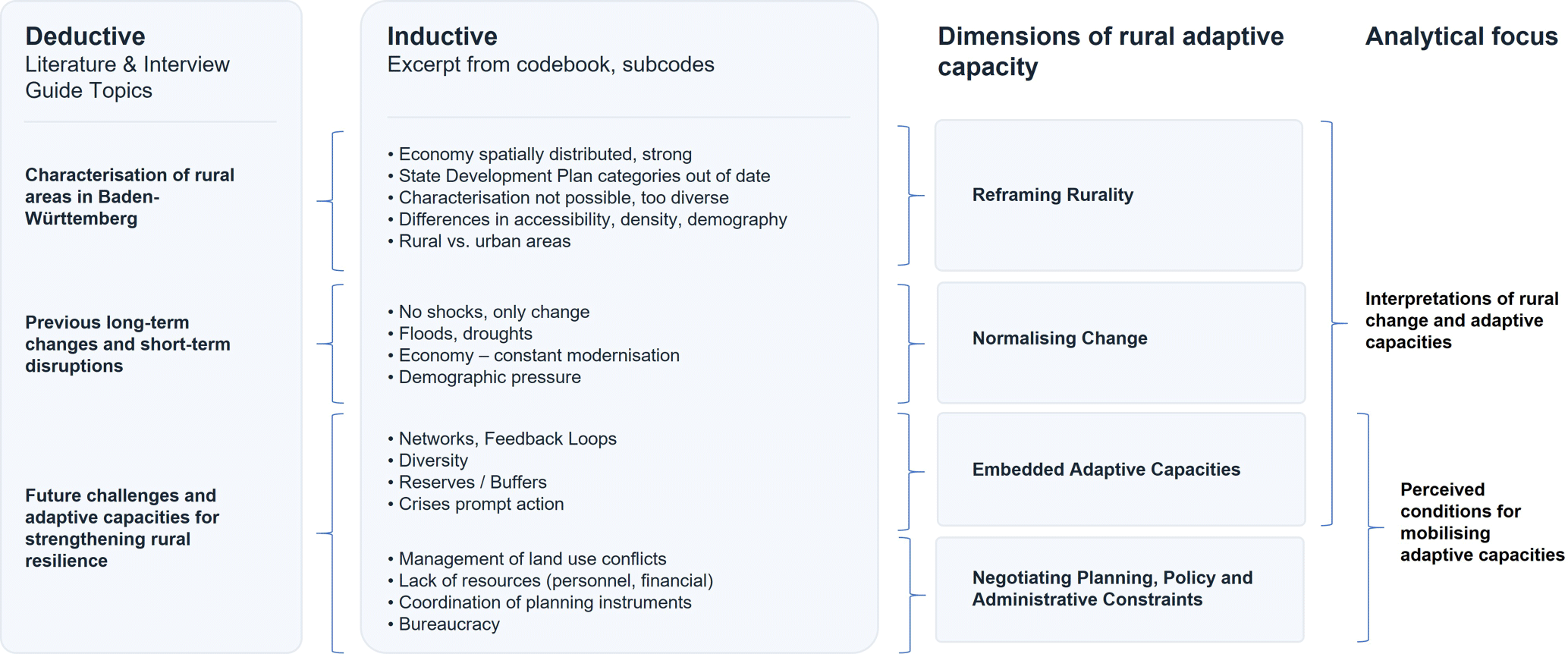
The analysis focuses on how actors construct problems and capacities in interview accounts. Expert interviews provide access to institutional knowledge, planning rationales and professional interpretations, but they do not offer a transparent account of organisational practice. Statements about economic success, social cohesion or the effectiveness of regional coordination may reproduce dominant narratives and institutional interests. We therefore treat quotations as situated claims and compare how similar issues are framed across the material. The analytical aim is thus to reconstruct the patterns through which rural adaptation becomes intelligible at the intermediate level.
The wider project also included a survey of rural mayors and five local community workshops. These materials informed the interpretation of the case but are not analysed systematically in this paper. However, the empirical claims in Section 4 are based on the sixteen expert interviews.
The interviews reveal how regional planning and administrative actors interpret rural change and the conditions they associate with adaptation. Four dimensions organise the analysis. Reframing rurality and normalising change concern the interpretative work through which rural capacities and disruptions become intelligible. Embedded adaptive capacities concern the relations between economic, social and institutional resources that interviewees associate with regional stability and renewal. Negotiating constraints concerns the planning and governance conditions under which these resources may be mobilised. The four dimensions are interrelated but analytically distinct.
Interviewees usually began by referring to the categories of the State Development Plan. Given their institutional position, this is unsurprising. Yet few considered these categories sufficient for understanding the areas for which they were responsible. One interviewee captured the tension succinctly: “Some areas are rural by definition. Yet this is only apparent because they are classified as such in the State Development Plan” (Interview, Regional Planning Association). The statement reflects a recurring pattern. Rurality is institutionally defined, but its practical meaning must be reworked in response to demographic, economic, infrastructural and environmental changes that static planning categories only partly capture.
Interviewees therefore described rurality through settlement density, topography, accessibility, infrastructure and the relationship to labour markets and services. In these accounts, rurality is neither a uniform territorial category nor simply the opposite of the urban. It is a relational condition shaped by different degrees and forms of connectivity. Remote locations may face long travel distances and dependence on individual mobility, while municipalities formally classified as rural may be closely integrated into urban labour markets or global production networks. Reframing rurality in this way brings both peripheral conditions and regional connections into view.
This relational interpretation also altered the scale at which problems were described. Interviewees rarely treated the municipal boundary as the natural unit of rural development. Employment, secondary schools, hospitals, retail and public transport were discussed through catchment areas and functional relationships that cut across local jurisdictions. A municipality with few services of its own could nevertheless be well connected to a nearby centre, while a formally central location might remain difficult to reach from dispersed settlements. The significance attributed to accessibility therefore depended not only on physical distance but on the organisation of mobility, the location of everyday services and the capacity of municipalities to cooperate.
The term ‘rural’ was itself contested. Some interviewees associated it with policy narratives of backwardness or deficit, even when they rejected these connotations. One argued that a future State Development Plan should replace the term: “It could be called a ‘space of potential’ or something similar, but not ‘rural area’, because the term is associated with backwardness or narrowness of mind” (Interview, Regional Planning Association). The point is not simply terminological. Renaming rural areas changes which characteristics are foregrounded and which development claims become legitimate.
Other accounts were less concerned with abandoning the term than with detaching it from a hierarchical opposition to the urban. Rurality was associated with proximity to nature, manageable settlement scales and attachments to local social life, but also with the effort required to maintain services and mobility over larger distances. These qualities could not be reduced to either advantage or disadvantage. The interviews instead suggest that rurality becomes politically consequential when selected characteristics are translated into eligibility criteria, planning priorities or expectations of local self-reliance. A positive revaluation can attract attention and investment, while also concealing the additional work needed to reproduce everyday life in less accessible places.
This becomes particularly clear in accounts of small and medium-sized firms and globally connected ‘hidden champions’. Interviewees presented these firms as evidence that rural areas can combine low settlement density with economic dynamism, skilled employment and international connections. As one interviewee put it, Baden-Württemberg’s economic structure “guarantees that rural areas do not have to be depicted so pessimistically” (Interview, Regional Planning Association). Rurality is reframed as productive rather than residual.
Reframing is therefore an interpretative dimension of adaptive capacity. It makes heterogeneity, connections and locally specific strengths visible and challenges deficit-oriented spatial categories. Yet this reframing is not neutral. A focus on productive rurality may privilege economically successful municipalities and understate the vulnerabilities of places with weaker labour markets, services or administrative capacity. The analysis consequently treats reframing as a planning perspective rather than evidence that rural areas are resilient.
A second pattern concerns the temporal interpretation of change. Interviewees rarely separated demographic ageing, economic restructuring, digitalisation or climate change into discrete challenges. Instead, they situated these processes within longer histories of regional adjustment. Change appeared not as an exceptional condition but as a recurrent feature of rural development. This perspective was particularly visible in accounts of crises. Interviewees acknowledged the global financial crisis, the pandemic and the economic effects of Russia’s war against Ukraine but often incorporated them into narratives of manageability. One interviewee summarised the preceding two decades as follows: “The major constant is that things have kept getting better. Yes, we had crises. It took three quarters of a year, and then things were better than before” (Interview, Regional Planning Association). Another condensed this interpretation into a striking formulation: “Looking back, one has to say: there were no crises, there was change” (Interview, Regional Planning Association).
The normalisation of disruption was one of the less anticipated findings of the analysis. Shocks did not disappear from the accounts, but their disruptive character was absorbed into a longer narrative of successful adjustment. Crises became episodes in a continuing development trajectory rather than moments that fundamentally called this trajectory into question. References to the principal challenges of recent decades as ‘more of the same’ expressed a similar orientation. However, this temporal framing was not equivalent to denying that disruptions had consequences. Interviewees referred to delayed investments, interruptions in supply chains, new administrative demands, and accelerated changes in mobility and work. During the pandemic, for example, digital communication and local forms of support were described as allowing institutions to continue operating, while weaknesses in connectivity and service provision became more visible. The interpretative move consisted of treating these effects as extensions or accelerations of existing processes. The boundary between shock and long-term pressure was consequently drawn retrospectively: an event appeared less exceptional when it could be incorporated into an established narrative of regional adjustment.
Economic restructuring reinforced this perspective. Interviewees described the transformation of the automotive sector as highly relevant to the economic foundations of rural Baden-Württemberg, but usually as a difficult and manageable process rather than a rupture. They referred to the adaptation of supplier networks, skills, production capacities and labour markets. Earlier structural change provided a narrative template. One interviewee recalled the decline of the clock industry in the Black Forest as a severe disruption from which new firms had emerged: “This structural break was overcome relatively quickly. New firms emerged from these small businesses. Today, we have almost full employment” (Interview, Regional Planning Association).
Historical analogies performed important work in these accounts. They provided evidence that skills and entrepreneurial capacities could be transferred across sectors, and they placed present uncertainty within a longer regional history. At the same time, analogies can be misleading when the scale, speed or institutional context of change differs. The transition from mechanical to electrical production, the restructuring of globally integrated automotive supply chains and the combined pressures of decarbonisation, digitalisation and geopolitical fragmentation are not interchangeable. The interview material reveals confidence in the capacity to adjust but offers less certainty about whether earlier institutional routines can respond to several simultaneous transformations.
In this vein, normalising change may support adaptive capacity by encouraging confidence, institutional learning and a pragmatic orientation towards problem-solving. It allows regional actors to connect short-term events to longer development trajectories and to identify resources that have been recombined before. At the same time, the pattern is ambivalent. A narrative of recurrent success may reduce sensitivity to changes that exceed earlier experience or affect several parts of the regional economy simultaneously. Normalisation can therefore stabilise action, but it can also depoliticise vulnerability and reinforce expectations that established development paths will remain viable.
Interviewees located adaptive capacity in relations between firms, labour markets, skills, infrastructure, civic institutions and social cohesion. None of these elements was considered sufficient in isolation. Their significance derived from how they supported one another in the everyday reproduction of regional economies and communities.
A diversified economic structure was central to these accounts. Small and medium-sized firms and globally connected manufacturers were associated with employment, local value creation and regional confidence. Interviewees nevertheless recognised the vulnerability created by dependence on individual firms. One described the relationship through the metaphor that “if [name of the company] catches a cold, the municipality ends up in intensive care” (Interview, Regional Planning Association). The capacity attributed to locally embedded firms therefore depended on their position within a wider economic structure.
The interviews differentiated between the local embeddedness of firms and local control over their development. Long-standing enterprises were valued because they maintained training, employment and relationships with municipalities, yet even strongly rooted firms were exposed to decisions in transnational markets and supply chains. Their expansion could generate local tax revenue and confidence while increasing pressure on land, housing and mobility. Economic strength was therefore interpreted as a bundle of interdependent effects rather than an isolated resilience resource. The same firm could support services and demographic stability, create dependence and intensify spatial conflict.
Sectoral diversity was presented as a buffer because industries are exposed to different cycles. As one interviewee explained, “these cycles often unfold differently across sectors, so we are not always hit hard all at once; one development may be balanced out by another” (Interview, Regional Planning Association). This interpretation corresponds to adaptive-systems thinking, but it emerged in the interviews as practical knowledge rather than explicit engagement with resilience theory. Diversity distributed exposure across firms and labour markets; it did not remove vulnerability.
Labour, skills and demographic renewal formed a second set of relations. Interviewees connected rural adaptation to the capacity to retain, attract and regain skilled workers, young families, public-sector employees and future owners of local businesses. Employment and short commuting distances were valued not only as economic advantages but as conditions for maintaining services and civic life. Universities of applied sciences, vocational education, digital infrastructure and remote working were described as resources for regional labour markets. Their absence could encourage the departure of younger residents. Skills were discussed as both an individual qualification and a regionally embedded capacity. Apprenticeship systems, specialised vocational knowledge and cooperation between firms and educational institutions were seen as allowing production systems to adjust incrementally.
However, skills closely tied to a dominant technological trajectory may not transfer automatically to new sectors. Interviewees consequently connected labour-market resilience to opportunities for further education, the accessibility of training and the attractiveness of rural locations for workers whose expectations extend beyond employment. Housing availability, childcare, cultural provision and digital connectivity entered the same relational chain.
Similarly, temporary outmigration was not always framed as loss. Some interviewees regarded departure for education or professional experience as a normal phase, given that return remained possible. “Young people should go out into the world for a while”, one argued, while another described their own trajectory: “It took me twenty years to come back” (Interviews, Regional Planning Associations). These statements expressed confidence in long-term attachment to place but also pointed to a fragile condition: return depends on employment, housing, infrastructure and social openness rather than attachment alone.
In this sense, social cohesion and civic institutions formed a third set of capacities. Interviewees associated volunteer fire brigades, local associations and dense social relations with practical self-organisation. During the pandemic, local solidarity was cited as a reason why crisis management had worked comparatively well. One interviewee argued that “when things get serious, rural areas organise themselves somewhat better” (Interview, Regional Planning Association). Such statements reveal how planning actors understand local capacity; they do not independently determine the effectiveness or inclusiveness of these networks.
Moreover, the interviews also pointed to the institutional preconditions of voluntary action. Associations require meeting places, reliable leadership, time and a sufficiently broad membership base. Where population ageing, long commuting distances or the closure of local facilities erode these conditions, appeals to civic engagement can shift responsibility without creating capacity. Newcomers may introduce knowledge and initiative, but their participation depends on whether established networks are open to them. Social cohesion should therefore be understood as an organisational accomplishment that requires renewal, not as a cultural attribute automatically attached to rural communities.
Our interview accounts also exposed the ambivalence of embedded strength. Long periods of prosperity and successful adjustment could encourage complacency. One interviewee described a mindset in which the possibility of decline was no longer considered: “Things are going well for us. Why do they need to get even better?” (Interview, Regional Planning Association). Close relations between firms, skills, institutions and local expectations may sustain development, but they can also reinforce dependency and narrow the range of futures that are considered plausible.
Embedded adaptive capacity is therefore relational rather than cumulative. Adding firms, infrastructure or civic organisations does not automatically strengthen resilience. What matters is how these resources are connected, whether they can be recombined and which dependencies they generate. Regional planning actors mainly observe and interpret these relations. They may support specific connections through infrastructure provision, intermunicipal coordination or the protection of development options, but they are one group of actors within a wider regional constellation.
The mobilisation of adaptive capacity depends on institutional and spatial conditions. Interviewees repeatedly discussed land-use conflicts, regulation, administrative resources and coordination across levels. In contrast to the previous three dimensions, this part of the analysis concerns more directly what regional planning actors seek to do: translate between levels, coordinate municipalities, identify cross-sectoral effects and mediate competing claims. Their room for manoeuvre remains limited by legal mandates, political decisions and resources controlled elsewhere.
Land availability was the most prominent example. Interviewees described developable land not simply as a resource for growth but as a condition of regional responsiveness. Rural municipalities may host globally connected firms and specialised suppliers, yet their capacity to accommodate expansion depends on land-use regulation, suitable sites and local political acceptance. One interviewee illustrated the resulting tension through the relationship between production and logistics: “Production and logistics are two cogwheels that can only run together. But in planning terms, we separate them very neatly. When a world market leader needs to expand, everyone says, ‘Excellent! We will do that immediately’. But when the logistics provider needs to expand, the answer is ‘never’” (Interview, Regional Planning Association). This illustrates how adaptive capacity can be restricted when functional economic relations are fragmented by planning categories and local political acceptance.
Similarly, several interviewees supported reducing greenfield development while criticising an exclusive focus on absolute land take. From their perspective, the absence of nearby logistics sites could increase transport distances and emissions. They consequently argued for land-use efficiency combined with carefully regulated reserves of developable land. This position framed spatial buffers as a condition of responsiveness. It also revealed a conflict that cannot be resolved through the language of capacity alone: land conservation, economic development and local acceptance embody different interests and distribute costs and benefits unevenly.
Administrative capacity constituted a second constraint. Interviewees described rural municipalities as facing more complex responsibilities in crisis management, infrastructure provision, climate adaptation and development coordination while lacking specialised staff. Regional planning and development bodies sought to support intermunicipal cooperation as a means of pooling expertise and reducing administrative burdens. As one interviewee argued, “There are certain issues that not every municipality has to deal with on its own”. Regional bodies could organise cooperation and “do more than simply colour areas on a map” (Interview, Regional Planning Association). Examples included joint industrial areas that individual municipalities would be unable to develop alone.
However, capacity constraints were not limited to the number of staff. Interviewees described difficulties created by fragmented responsibilities, changing funding programmes and the need to coordinate increasingly specialised legal and technical knowledge. Smaller municipalities may be eligible for support while lacking the personnel required to prepare applications, manage procurement or sustain projects after the funding period. Intermunicipal cooperation can reduce duplication, but it also requires agreements over costs, locations and political visibility. Regional coordination is therefore not a cost-free substitute for local administration. It is an additional institutional task whose effectiveness depends on trust, continuity and clear responsibility.
Housing, mobility, climate policy and affordability illustrated the need for cross-sectoral coordination. Interviewees noted that households may prefer locations close to public transport but be displaced towards more affordable and car-dependent settlements. From their perspective, sectoral policy could therefore undermine wider climate and accessibility objectives. Regional planning made such interdependencies visible, but did not control housing markets, transport investment or municipal land policy.
The mismatch between planning time and economic time recurred across these issues. Formal plan revisions are designed to create legal certainty and to balance claims over long periods, whereas firms, households and municipalities often seek decisions within much shorter horizons. Interviewees did not argue that planning should simply accelerate. Predictability, environmental assessment and participation were recognised as necessary safeguards. The concern was that rigid procedures or insufficiently coordinated sectoral rules could consume the very buffers needed to respond to change. From this perspective, adaptability depends on combining stable rules with options that can be activated when circumstances shift.
Beyond this, the energy transition brought questions of scale and distributive conflict to the fore. National and state targets require regional planning bodies to designate areas for renewable-energy infrastructure. Interviewees reported growing acceptance but also the perception that rural areas were carrying spatial burdens for urban centres. One asked: “Why should we produce more energy in rural areas than we need just because cities cannot manage it themselves? Why ground-mounted photovoltaics? Why not install more on rooftops?” (Interview, Regional Planning Association). Regional planners described their role as translating between policy levels and explaining competing needs. Yet mediation does not remove the underlying conflict over whose landscapes, land and resources are mobilised for the transition. More pragmatic adaptations complicated these oppositions. Some farmers were described as using ground-mounted photovoltaic installations to stabilise agricultural income or provide an alternative where no successor was available. One interviewee referred to “reliable pension income” and “easier work than working the fields every year” (Interview, Regional Planning Association). Such examples show how new combinations of land use, economic security and energy production can emerge, while remaining contested.
However, they also show why the direction of adaptation cannot be derived from sectoral targets alone. The same photovoltaic installation can contribute to renewable-energy production, alter agricultural landscapes, change land values and provide income that maintains a household or farm. Whether it is interpreted as adaptive depends on the spatial scale, time horizon and interests that are foregrounded. Regional planning brings these claims into relation, but it cannot resolve their normative differences through technical coordination. Decisions inevitably privilege some uses and future options over others.
Negotiating constraints is therefore a governance dimension of rural adaptive capacity. Regional planning may connect local needs to strategic frameworks, coordinate across municipalities and mediate conflicts that cannot be resolved locally. It neither possesses nor produces rural resilience on its own. Our interview material instead shows how planning actors interpret the institutional conditions under which capacities can be mobilised, and how they seek to influence these conditions alongside municipalities, firms, sectoral authorities, civic organisations and residents.
Our analysis gives empirical specificity to a literature-derived understanding of rural resilience as adaptive capacity under conditions of permanent change. It reconstructs how actors at the intermediate planning level interpret change and the conditions they associate with adaptation. The four analytical dimensions connect these accounts to three concerns: the interpretation of rurality and the normalisation of change; the relational constitution of capacities; and the governance of their mobilisation.
In this sense, the first contribution is interpretative. Rurality and change become meaningful within planning through categories, narratives and professional judgements. Reframing rurality enables planning actors to challenge deficit-oriented categories and recognise economic connections, local knowledge and place-specific strengths. Normalising change situates disruptions within longer histories of adjustment. These interpretations can support action, but they can also obscure vulnerability. Productive rurality may privilege already successful places, while narratives of continuous adjustment may understate the possibility of more fundamental rupture.
This perspective questions the treatment of resilience factors as pre-existing attributes awaiting identification. Before a resource can inform planning, it must be rendered spatially relevant and connected to an anticipated problem. A specialised firm may appear as a source of employment, a dependency or a claim on scarce land; voluntary organisation may be interpreted as social capacity or as compensation for service withdrawal. However, these meanings are shaped by institutional mandates and understandings of desirable development. The intermediate level matters because it assembles local differences into regional accounts that can inform formal decisions.
Normalising change also reveals how actors connect immediate disruption, historical interpretation and anticipated futures. Confidence in earlier renewal can sustain practical problem-solving, but it rests on a selective reading of which changes count as precedent. Wilson’s (2014) account of economic, structural and socio-psychological lock-in helps explain how past success may reinforce expectations of continuity. The same relations that enabled earlier adjustment may become restrictive when pressures intensify or combine. Adaptive capacity therefore requires institutional memory to remain open to experiences that challenge established interpretations.
Our second contribution is relational. Interviewees associated regional adaptation with connections between firms, skills, infrastructure, civic institutions and social cohesion. Employment supports demographic stability and services; infrastructure connects local labour and firms to wider systems; civic organisation may enable practical self-help; education and return migration renew skills. These relations may sustain regional development while also generating dependency. This ambivalence illustrates the distinction between adaptation within an established development path and adaptability beyond it (Pike/Dawley/Tomaney 2010). The analytical question concerns whether resources can be recombined when the relations that previously sustained them become restrictive.
The third contribution concerns governance. The mobilisation of capacities depends on regulation, authority, administrative resources and coordination across territorial levels. Regional planning provides an arena in which these conditions are interpreted and partly organised. Its distinctive contribution lies in comparison, translation and the anticipation of cross-boundary effects: identifying regional dependencies arising from municipal decisions, preserving sites or corridors for future use, and bringing sectoral claims into a common spatial frame. Yet these capacities remain conditional. Plans require political approval, implementation depends on other authorities and municipalities, firms or higher levels of government control many of the resources involved. The interviews reveal both the importance and the limits of this intermediate position.
These limits also direct attention to power and conflict. Land reserves may increase the responsiveness of firms and municipalities while weakening land-conservation objectives. Renewable-energy infrastructure may strengthen energy capacity while concentrating spatial burdens in rural areas. Social cohesion may support self-organisation while excluding less-established groups. Resilience is therefore neither politically neutral nor necessarily shared. The critical questions concern which functions and development paths are sustained, whose capacity to act is strengthened, and how costs and vulnerabilities are distributed (Davoudi 2012; MacKinnon/Derickson 2013).
Such distributions are often embedded in apparently technical decisions. Thresholds for land take, renewable-energy designations and transport connections shape which forms of development remain possible and who bears their consequences. The language of resilience can depoliticise such decisions when it presents them as necessary adjustments to external change. Understanding adaptive capacity as governed instead brings contestation into the analysis: questioning priorities, representing competing interests and revising arrangements become integral to adaptation.
This perspective also clarifies what resilience adds when planning already involves continuous adjustment. Planning provides stability, predictability and procedures for reconciling competing claims, but these functions do not guarantee adaptability. A resilience perspective asks whether institutions can recognise emerging vulnerabilities, retain buffers, recombine resources and revise established development paths. Its analytical value lies in examining the tension between institutional stability and the preservation of future room for action.
The pressures discussed by interviewees illustrate this tension. Automotive restructuring, decarbonisation, demographic change and geopolitical uncertainty may interact in ways that challenge familiar forms of adjustment. Skills may not transfer at the required pace; economic restructuring may intensify competition over land; and municipalities may acquire responsibilities without corresponding administrative resources. Earlier success provides experience and resources but cannot establish whether existing arrangements will remain adequate under changing combinations of pressure.
However, our research has three principal limitations. First, it reconstructs the perspectives of senior regional planning and administrative actors, whose professional mandates may encourage accounts that legitimise their organisations. Second, perceptions of successful adjustment cannot establish actual resilience outcomes, which would require longitudinal evidence and the tracing of responses to specific disruptions. Third, the analysis aggregates across planning regions and two types of institution without systematically explaining regional or organisational differences.
These limitations define a focused research agenda. Comparing how planners, mayors, firms, civic organisations, and residents frame and interpret the same changes and conflicts would reveal competing definitions of capacity and vulnerability. Longitudinal research could assess whether the capacities identified here support responses to disruption or reproduce established dependencies. Tracing contested planning decisions would further show whose resources are mobilised, whose vulnerabilities remain unaddressed or even invisible, and how regional adaptation redistributes costs and opportunities.
Rural resilience is often approached through lists of economic, social or institutional factors. This paper has instead examined how such capacities are interpreted, connected and governed at the intermediate planning level. Based on four analytical dimensions, we have demonstrated why rural adaptation cannot be reduced either to local community strength or to regional planning intervention.
The interview accounts highlight how strong rural economies and dense local networks do not eliminate vulnerability. They create resources for adjustment while producing dependencies, expectations and spatial claims that may restrict later choices. Equally, planning does not stand outside these relations. Through categories, priorities and procedures it makes some capacities visible, preserves some options and renders others more difficult to pursue. The intermediate planning level is consequently a useful site for observing how local resources, sectoral policies and state objectives are translated into a regional understanding of change.
The contribution is a qualified conception of rural adaptive capacity as interpretative, relational and governed. Planning actors make heterogeneous capacities and vulnerabilities visible, connect issues across sectors and seek to mediate between levels. Their accounts also reveal the limits of established development paths and institutional arrangements. Rural resilience consequently lies not in returning to an earlier state or maintaining every existing structure, but in retaining the capacity to recognise vulnerability, recombine resources and contest the direction and distribution of change.
This conception avoids treating resilience as a label for successful places. It directs attention instead to whether institutions can learn from earlier change without assuming that it will repeat, whether resources can be redirected beyond established paths and whether conflicts over adaptation can be addressed openly. For rural planning, governing permanent change therefore means preserving both stability and the possibility of revision. The quality of resilience lies less in uninterrupted continuity than in the capacity to keep alternative futures politically and institutionally available.
References
| Adam Hernández, A. (2021): Das resiliente Dorf. Eine interdisziplinäre Analyse von Akteuren, Lernprozessen und Entwicklungen in drei ländlichen Gemeinschaften Europas. München. = Hochschulschriften zur Nachhaltigkeit 92. |
| BBSR – Bundesinstitut für Bau‑, Stadt- und Raumforschung (2012): Raumordnungsbericht 2011. Bonn. |
| BBSR – Bundesinstitut für Bau‑, Stadt- und Raumforschung (2024): Resilienz und Zentralität. Krisenfeste Raum- und Infrastrukturen durch zentralörtliche Konzepte. Bonn. https://doi.org/10.58007/nzh3-rs47 |
| BMI – Bundesministerium des Innern, für Bau und Heimat (ed.) (2021): Memorandum Urbane Resilienz. Wege zur robusten, adaptiven und zukunftsfähigen Stadt. Berlin. |
| Davoudi, S. (2012): Resilience: A bridging concept or a dead end? In: Planning Theory and Practice 13, 2, 299–307. https://doi.org/10.1080/14649357.2012.677124 |
| Eberhardt, W.; Küpper, P.; Seel, M. (2022): Chancen und Risiken der Digitalisierung für Dorfläden: Corona-Pandemie als Katalysator? In: Raumforschung und Raumordnung | Spatial Research and Planning 80, 3, 344–359. https://doi.org/10.14512/rur.121 |
| Fath, B.D.; Dean, C.A.; Katzmair, H. (2015): Navigating the adaptive cycle: an approach to managing the resilience of social systems. In: Ecology and Society 20, 2, 24. https://doi.org/10.5751/ES-07467-200224 |
| Gunderson, L.H.; Holling, C.S. (eds.) (2002): Panarchy: understanding transformations in human and natural systems. Washington, D.C. |
| Heijman, W.; Hagelaar, G.; van der Heide, M. (2019): Rural resilience as a new development concept. In: Dries, L.; Heijman, W.; Jongeneel, R.; Purnhagen, K.; Wesseler, J. (eds.): EU Bioeconomy Economics and Policies. Volume II. Cham, 195–211. https://doi.org/10.1007/978-3-030-28642-2_11 |
| Hooghe, L.; Marks, G. (2003): Unraveling the central state, but how? Types of multi-level governance. In: American Political Science Review 97, 2, 233–243. https://doi.org/10.1017/S0003055403000649 |
| IREUS – Institut für Raumordnung und Entwicklungsplanung der Universität Stuttgart; ILS – Institut für Landes- und Stadtentwicklungsforschung (2020): Entwicklung der Ländlichen Räume in Baden-Württemberg. Forschungsvorhaben im Auftrag des Ministeriums für Ländlichen Raum und Verbraucherschutz Baden-Württemberg. Stuttgart. |
| Jakubowski, P. (2013): Resilienz – eine zusätzliche Denkfigur für gute Stadtentwicklung. In: Informationen zur Raumentwicklung 4, 371–378. |
| Janoschka, M.; Hitzeroth, M.; Ross, S. (2024): Resilienz der ländlichen Räume in Baden-Württemberg: Ein Konzept. Endbericht zum Projekt im Rahmen der interministeriellen Arbeitsgruppe „Resiliente Ländliche Räume“ des Kabinettsausschusses Ländlicher Raum. Karlsruhe. https://doi.org/10.5445/IR/1000173489 |
| Jessop, B. (1998): The rise of governance and the risks of failure: The case of economic development. In: International Social Science Journal 50, 155, 29–45. https://doi.org/10.1111/1468-2451.00107 |
| Kuhlicke, C. (2018): Resiliente Stadt. In: Rink, D.; Haase, A. (eds.): Handbuch Stadtkonzepte. Analysen, Diagnosen, Kritiken und Visionen. Opladen, 359–380. |
| Li, Y. (2023): A systematic review of rural resilience. In: China Agricultural Economic Review 15, 1, 66–77. https://doi.org/10.1108/CAER-03-2022-0048 |
| MacKinnon, D.; Derickson, K.D. (2013): From resilience to resourcefulness: A critique of resilience policy and activism. In: Progress in Human Geography 37, 2, 253–270. https://doi.org/10.1177/0309132512454775 |
| McAreavey, R. (2022): Finding rural community resilience: Understanding the role of anchor institutions. In: Journal of Rural Studies 96, 227–236. https://doi.org/10.1016/j.jrurstud.2022.10.014 |
| Ostrom, E. (1990): Governing the commons: The evolution of institutions for collective action. Cambridge. |
| Pike, A.; Dawley, S.; Tomaney, J. (2010): Resilience, adaptation and adaptability. In: Cambridge Journal of Regions, Economy and Society 3, 1, 59–70. https://doi.org/10.1093/cjres/rsq001 |
| Rink, D.; Gebauer, R.; Haase, A.; Intelmann, D.; Kabisch, S.; Kuhlicke, C.; Schmidt, A. (2024): Die resiliente Stadt: Forschungsstand in Deutschland, definitorische und konzeptionelle Überlegungen. In: Kabisch, S.; Rink, D.; Banzhaf, E. (eds.): Die Resiliente Stadt. Konzepte, Konflikte, Lösungen. Berlin, 3–21, https://doi.org/10.1007/978-3-662-66916-7_1 |
| Salvia, S.; Quaranta, G. (2015): Adaptive Cycle as a Tool to Select Resilient Patterns of Rural Development. In: Sustainability 7, 8, 11114–11138. https://doi.org/10.3390/su70811114 |
| Salvia, S.; Quaranta, G. (2017): Place-based Rural Development and Resilience: A Lesson from a Small Community. In: Sustainability 9, 6, 889. https://doi.org/10.3390/su9060889 |
| Simmie, J.; Martin, R. (2010): The economic resilience of regions: towards an evolutionary approach. In: Cambridge Journal of Regions, Economy and Society 3, 1, 27–43. https://doi.org/10.1093/cjres/rsp029 |
| Specht, J.; Wenz, K.; Weber, M: Häring, A.M.; Braun, C.L. (2013): Wandel im ländlichen Raum: Von Wandlungsprozessen zu neuen Kompetenzbedarfen. Eberswalde. = Schriften zu den Wirtschafts- und Sozialwissenschaften der Land- und Lebensmittelwirtschaft 1/2013. |
| Stognief, N.; Walk, P.; Schöttker, O.; Oei, P.-Y. (2019): Economic Resilience of German Lignite Regions in Transition. In: Sustainability 11, 21, 5991. https://doi.org/10.3390/su11215991 |
| Troeger-Weiß, G. (2018): Raumbezogene Risiken und regionale Resilienz. Neue Ansätze in der Standortforschung und für Standortstrategien von Regionen, Kommunen und Unternehmen. In: Pechlaner, H.; Tretter, M. (eds.): Keine Strategie ohne Verantwortung. Perspektiven für eine nachhaltige Standort- und Regionalentwicklung. Wiesbaden, 91–115. https://doi.org/10.1007/978-3-658-22557-5_8 |
| Troeger-Weiß, G. (2022): Resiliente Regionen und Kommunen: Rahmenbedingungen, Trends, Perspektiven und Strategien. In: Pechlaner, H.; Zacher, D.; Störmann, E. (eds.): Resilienz als Strategie in Region, Destination und Unternehmen. Eine raumbezogene Perspektive. Wiesbaden, 167–182. https://doi.org/10.1007/978-3-658-37296-5_6 |
| Walker, B.; Salt, D. (2006): Resilience Thinking: Sustaining Ecosystems and People in a Changing World. Washington, D.C. |
| Wilson, G.A. (2014): Community resilience: path dependency, lock-in effects and transitional ruptures. In: Journal of Environmental Planning and Management 57, 1, 1–26. https://doi.org/10.1080/09640568.2012.741519 |
| Zerrer, N.; Sept, A.; Christmann, G.B. (2022): Rural Community Development Click-by-Click. Processes and dynamics of digitally supported social innovations in peripheral rural areas. In: Raumforschung und Raumordnung | Spatial Research and Planning 80, 3, 314–328. https://doi.org/10.14512/rur.145 |